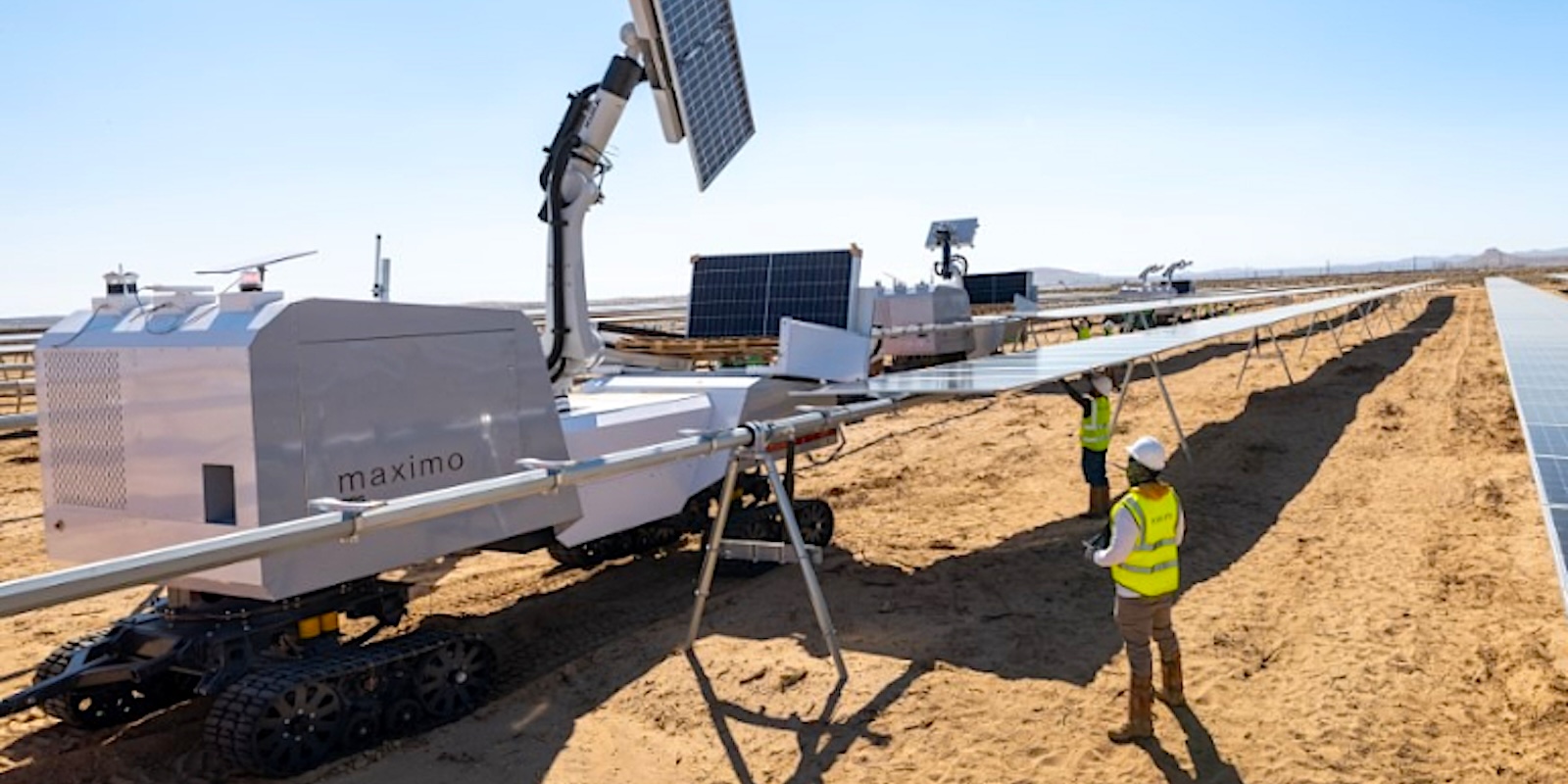
After completing the first half of the Bellefield complex last summer, Maximo engineers have put their helpful robot friend into high gear, with the latest version 3.0 robot-equipped construction crews installing as many as 24 solar panel modules per hour, per person. And now, the company is reporting that Maximo has completed its 300,000th construction task. (!)
If that 24 modules per hour, per person rate sounds fast, that’s because it is. At full tilt, the latest Maximo robot-equipped crews have nearly doubled the output of traditional installation methods at similar solar locations throughout Southern California. Now, with 300,000 tasks under its belt, the robot is proving to be both fast and durable.
“The future of solar construction depends on bringing together the experience of our people and new technology,” explains Matt Tetrault, President of Primoris’ Renewables business.
Max’ed out
 Image by Maximo Robotics.
Like just about everyone these days, Maximo is playing up its machines’ NVDIVIA hardware, re-branding its robots’ repetitive automation as “physical AI.” That’s not to say the robots don’t work, however – as their deployment at Amazon’s Bellefield solar field is proving.
(By) leveraging NVIDIA AI infrastructure together with NVIDIA Omniverse libraries and NVIDIA Isaac Sim open robotics simulation framework, the Maximo team was able to develop, test and refine robotic capabilities through physics-based simulation and AI driven modeling before deploying updates in the field. The combination of AI, vision, robotics and simulation driven engineering reduced development and validation timelines and increased confidence in field performance as the robotic fleet scaled.
Amazon Web Services (AWS) powered the development, deployment, and operation of Maximo’s AI-driven field systems. AWS provides scalable computing, automated software delivery, and advanced data analytics, including real-time construction intelligence, enabling Maximo to collect operational robotics data and continuously improve performance.
The rapid deployment of solar panels at utility scale projects like this one, which is set to eventually reach over a GW of solar generating capacity, will help companies like Amazon reduce their carbon footprint, of course – but also save them big money as the price of fossil fuels continues to climb.
The Maximo team says it has plans to extend its robots potential use cases beyond solar and into construction tasks that require similar pick and place and feeding and attaching movements, site logistics, and site cleanup. And like just about every other business that demands a high degree of physical labor, the construction industry is facing huge labor shortages, making machines like Maximo that provide real efficiency gains welcome additions to the job site.

If you’re considering going solar, it’s always a good idea to get quotes from a few installers. To make sure you find a trusted, reliable solar installer near you that offers competitive pricing, check out EnergySage, a free service that makes it easy for you to go solar. It has hundreds of pre-vetted solar installers competing for your business, ensuring you get high-quality solutions and save 20-30% compared to going it alone. Plus, it’s free to use, and you won’t get sales calls until you select an installer and share your phone number with them.
Your personalized solar quotes are easy to compare online and you’ll get access to unbiased Energy Advisors to help you every step of the way. Get started here.
FTC: We use income earning auto affiliate links. More.
Subscribe to Electrek on YouTube for exclusive videos and subscribe to the podcast.