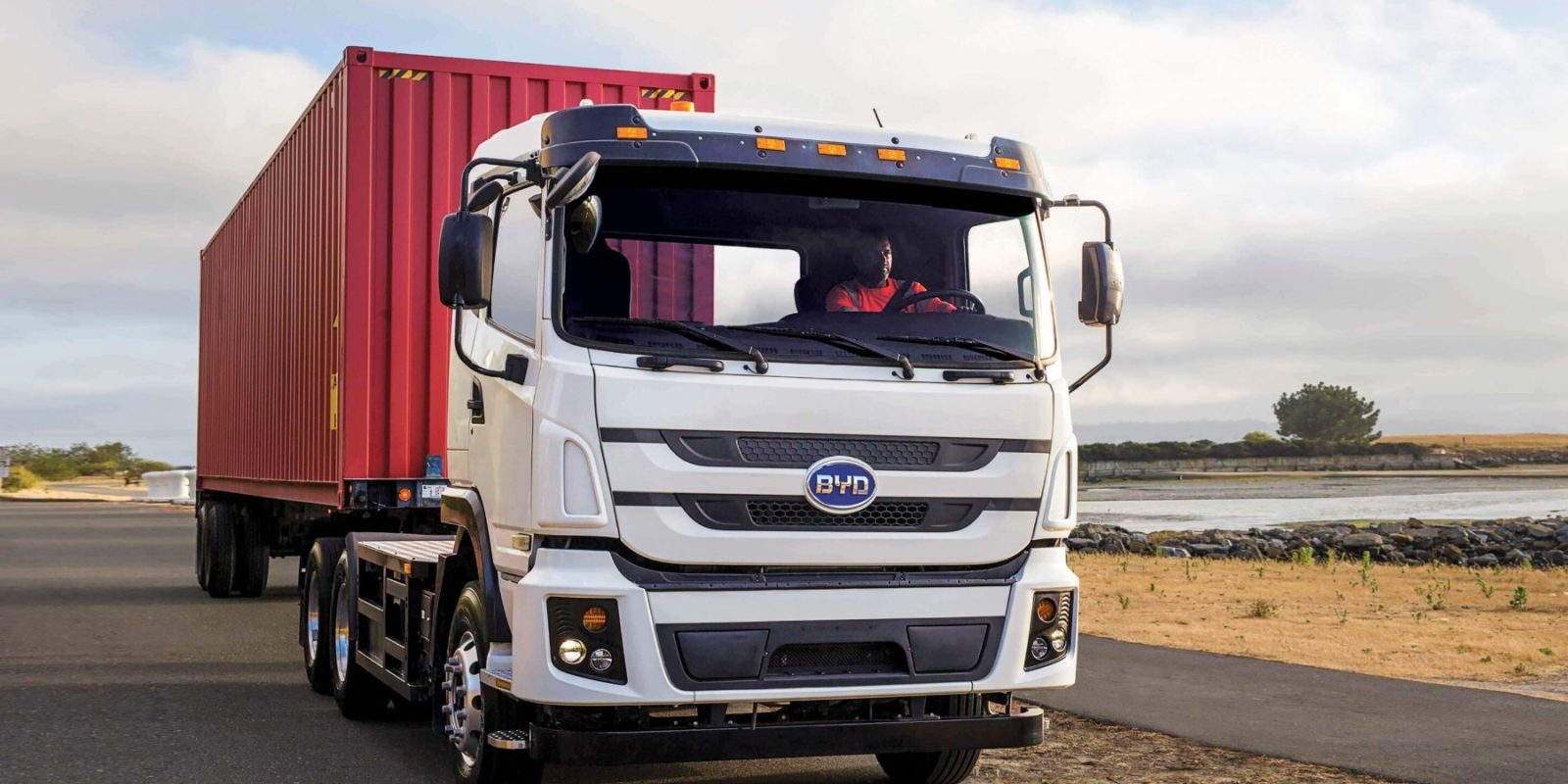
Electric trucks made up 50.3% of all heavy trucks sold in China in September. That’s 33,100 electric big rigs in a single month, up 37% from a year ago, while the overall heavy-truck market shrank by 21%.
And it’s showing up in the oil data. China’s diesel demand is on track to fall by about 230,000 barrels per day this year, and trucks running on batteries and natural gas are doing most of the work.
From 14% to half in under two years
In 2024, new-energy vehicles accounted for 13.6% of heavy trucks (12 tonnes and up) sold in China. In 2025, sales nearly tripled to 231,100 units, up 182%, for a 28.9% share.
 Electric heavy trucks passed 50% of China’s sales in September 2026.
December 2025 hit 53.9%, but that was a rush. Buyers piled in before trade-in subsidies expired and new purchase tax costs kicked in, and the share dropped back to about 23% by March.
Then it came right back. Through the first nine months of 2026, China sold 226,400 electric heavy trucks, up 64%, for a 38.1% share. That’s already almost as many as in all of 2025, with a quarter still to go. In tractors, the big rigs that pull long-haul trailers, the September share hit 64.5%.
 China sold almost as many electric heavy trucks in nine months of 2026 as in all of 2025.
That’s well ahead of Beijing’s own plan. This year, 11 government bodies set a target of 40% new-energy heavy-truck sales by 2030, along with 1.6 million of them on the road, 30,000 km of zero-carbon freight corridors and about 3,000 charging and swap stations. The market blew past that sales target four years early on a monthly basis, and CATL now says new-energy trucks will be half of China’s annual truck sales by 2028.
Why Chinese fleets are switching
It comes down to cost. In most uses, an electric heavy truck in China is now cheaper to own and run than a diesel one, and fleets run that math every day.
CATL claims savings of about 0.6 yuan per km. Independent numbers are more measured, but still favorable: a study by the ICCT and China’s CATARC found battery-electric trucks about 19% cheaper per tonne-km than diesel in good conditions, though they lose that edge at low annual mileage or when battery weight eats into payload.
Charging time is the other objection, and China’s answer is swapping. CATL’s Qiji brand operated about 300 heavy-truck swap stations at the end of 2025 and plans 900 by the end of this year and 2,000 in 2027. In August, it agreed to pay 2.56 billion yuan (about $370 million) for nearly 25% of Qiyuan Green Power, China’s largest heavy-truck swap operator with more than 1,600 charging and swap stations. Its new standardized packs hold 432 kWh and 513 kWh and swap in about five minutes.
CATL is already taking the swapping model to Europe with Octopus Energy.
The trucks themselves are domestic. XCMG led the segment in 2025 with a 15.4% share, ahead of SANY and FAW Jiefang, and the top three held 42.9% of the market. CATL supplied 60% of the batteries.
Electric is eating LNG, too
For years, the alternative to diesel trucks in China was liquefied natural gas. LNG trucks took nearly 30% of the market in 2024, when gas was much cheaper than diesel.
Now they’re losing to batteries. According to Kpler, LNG trucks had a 37% share of heavy-duty registrations in March, against 23% for electric. By July, electric was at 47% and LNG had collapsed to 11%. Monthly LNG truck registrations fell from more than 30,000 to about 6,200.
 Electric trucks overtook LNG trucks in China’s heavy-duty registrations in 2026.
So China is skipping the “bridge fuel” phase for trucks almost as fast as it started it.
Diesel demand is falling
China’s diesel consumption already peaked. Rhodium Group found that diesel refinery runs topped out in April 2023, and apparent consumption dropped from 4.7 million barrels per day then to 4.0 million barrels per day in April 2025.
2026 is the steepest drop yet. Kpler estimates diesel demand fell about 420,000 barrels per day year-over-year in May, roughly 10%, and 460,000 in June. It expects a decline of about 230,000 barrels per day for the full year and only a 64,000 barrel-per-day rebound in 2027.
 LNG and electric trucks displaced about 680,000 barrels per day of diesel in China in 2026, according to Kpler.
Kpler puts the gross diesel displacement from alternative trucks at about 680,000 barrels per day this year: roughly 450,000 from the LNG fleet built in recent years and 230,000 from electric trucks. Road freight still grew about 3% through July. China is moving more goods with less diesel.
There’s a catch. The fuel price spike this spring, tied to the Iran war, cut demand on its own and pushed more fleets toward electric. But that only explains part of it, and the fleet is still early: electric trucks will be only about 8% of China’s heavy trucks on the road by the end of 2026, according to Kpler. Every year of 40-50% sales shares compounds the diesel losses.
Meanwhile in Europe and the US
Europe is growing fast from a tiny base. ACEA data shows 5,120 heavy electric trucks (16 tonnes and up) registered in the EU through September, up 59.9%, for a 2.5% share. That’s up from 1.7% a year ago, but diesel still took 91.7% of all EU truck registrations.
A few countries stand out. Switzerland is at 24%, Norway 14.4%, the Netherlands 11.1% and Sweden 10.3%. Germany registered the most units at 1,722, but that’s only a 4.2% share.
The US doesn’t publish an official electric Class 8 sales figure, and that tells you something. The best indicator is the recent order for 2,500 Tesla Semis through ZET SCALE, which would roughly double the number of electric Class 8 trucks on US roads. Against about 230,000 Class 8 trucks sold per year, the electric share is well under 1%.
 China’s electric share of heavy-truck sales is more than 15 times Europe’s.
Price is the big difference. The ICCT puts the median electric Class 8 tractor in the US at $411,200, against $172,500 for diesel. Federal tax credits for commercial EVs ended in 2025, and California shelved the rule that would have required fleets to buy zero-emission trucks.
Electrek’s Take
This is the biggest under-covered story in the EV industry right now.
Everyone argued for years about whether electric semis could work. Range, weight, charging, cost. China settled it the boring way. It got the price of a battery-electric heavy truck close enough to diesel, built swap stations along freight routes, and let fleet operators do what fleet operators always do: pick the cheapest truck per kilometer.
And the result is showing up where it matters, in oil demand. Trucks are where diesel lives. Displacing a quarter of a million barrels a day in one year, with electric trucks still only around 8% of the fleet, means we’re still early on this curve.
The contrast with the US is hard to watch. America has Tesla, a Semi factory in Nevada built for 50,000 trucks a year, and some of the best freight corridors in the world for electrification. But electric Class 8 trucks cost 2.4 times as much as diesel here, the federal incentives are gone, and the market is under 1%. The ZET SCALE order is real progress. But it came from shippers pooling their demand, and twe have yet to see these trucks get delivered.
Europe at least has the regulation, and its best markets, at 10% to 24%, are roughly where China was in 2024 and 2025.
The question now is how long Chinese truck makers stay home. SANY and BYD already sell electric trucks in Europe, and CATL is building the swap network for them. If those trucks can come close to China’s pricing, how long can Western truck makers keep charging 2x diesel?
Diesel trucks aren’t the only thing batteries are displacing. At home, pairing solar with an EV or a home battery can cut your energy bills dramatically. With electricity rates up almost 10% last year and expected to keep climbing, going solar is one of the best ways to protect yourself against rising costs. And with lease and PPA options, you can do it with zero upfront cost and start saving immediately. If you want to find the best deal, check out EnergySage. It’s a free service with hundreds of pre-vetted installers competing for your business, so you save 20 to 30% compared to going it alone. No sales calls until you pick an installer. Get your free quotes here.
FTC: We use income earning auto affiliate links. More.
Subscribe to Electrek on YouTube for exclusive videos and subscribe to the podcast.