Experts say the decision to enter the race reflects Singapore’s record of championing the rule of law through multilateralism, the peaceful settlement of international disputes, and the observance of international law.
Singapore’s candidate Rena Lee, seen here presiding over an intergovernmental conference on marine biodiversity in March 2023, is one of 10 candidates vying for five contested seats on the Peace Palace bench in The Hague for the 2027 to 2036 term. (AP Photo/Peter Dejong, file)


SINGAPORE: When the United Nations convenes in New York on Tuesday (Nov 3) to elect judges to the International Court of Justice (ICJ), Singapore will be watching keenly with unprecedented interest.
For the first time since joining the UN as a newly independent nation in 1965, Singapore has fielded a candidate – Ms Rena Lee, 57 – for the world’s highest judicial bench.
The bid is seen as far more than an individual milestone for Singapore. Securing a seat on the 15-judge ICJ, also known as the World Court, goes to the core of its foreign policy and security as a small island nation.
“For small states, governance by international law is not a matter of choice but one of survival,” Minister for Law and Second Minister for Home Affairs Edwin Tong said at the UN headquarters in New York on Oct 29, a few days ahead of the ICJ vote.
Addressing the 193-member UN General Assembly (UNGA), Mr Tong said upholding international law and the UN Charter is paramount to ensure that “might does not make right” in an increasingly contested world, especially for small states.
“All states, big or small, old or young, are treated as sovereign equals before the court,” he said, referring to the ICJ.
In that light, the coming vote for a coveted spot on the ICJ is one to watch, analysts told CNA.
Singapore’s candidate Lee, who is also the country’s Ambassador for International Law, is one of 10 candidates vying for five contested seats on the Peace Palace bench in The Hague for the 2027 to 2036 term.
Her candidature was first announced in 2024, and she was formally nominated in 2026.
Should she win, she would make history as the first female ICJ judge from Southeast Asia and one of the first women from a small nation to serve on the court.
"This (outcome would be) a very significant - and, from my perspective, a welcome, if not historic, development," said Associate Professor Vincent-Joël Proulx from the National University of Singapore’s faculty of law.
The decision to enter the race reflects Singapore’s record of championing the rule of law through multilateralism, the peaceful settlement of international disputes, and the observance of international law, observers said.
"By providing its expertise in international law and dispute resolution through its candidate, Singapore would not only further champion peaceful dispute resolution and a rules-based multilateral community of states, but also contribute to enhancing the consistency, stability, and predictability of international law," said Assoc Prof Proulx.
Singapore’s willingness to participate in ICJ’s electoral process, despite the considerable campaigning and lobbying resources involved, shows the country’s confidence in international law institutions, he added.
CNA Games
 Guess Word
Crack the word, one row at a time
 Buzzword
Create words using the given letters
 Mini Sudoku
Tiny puzzle, mighty brain teaser
 Mini Crossword
Small grid, big challenge
 Word Search
Spot as many words as you can
Show More
Show Less
What does the International Court of Justice do?
As the UN's principal judicial organ, the ICJ adjudicates legal disputes between sovereign states that they agree to submit to the ICJ, and may give advisory opinions to the General Assembly or Security Council, involving international law, said senior lecturer Michael Ng from the School of Law at the Singapore University of Social Sciences.
What does the International Court of Justice do?
The ICJ is distinct from the International Criminal Court, which prosecutes individuals for international crimes like genocide and war crimes.
Established in 1945 under the UN Charter, the 15-judge ICJ deals principally with settling legal disputes submitted by states and issuing advisory opinions on legal questions referred to it by authorised UN bodies and agencies.
In other words, the ICJ serves as a rules-based dispute mechanism allowing UN member states to resolve international disagreements peacefully through law, rather than through conflict and coercion.
Singapore has previously participated in proceedings before the court. In 2008, the ICJ resolved a long-standing territorial dispute with Malaysia over Pedra Branca.
The ICJ awarded sovereignty over Pedra Branca to Singapore and Middle Rocks to Malaysia, while ruling that South Ledge belonged to whichever state's territorial waters it falls within.
Malaysia subsequently sought revision and interpretation of the judgment in 2017, but withdrew both proceedings in 2018.
More recently, the court has addressed prominent disputes and questions involving armed conflict, climate change, and states’ obligations under international law.
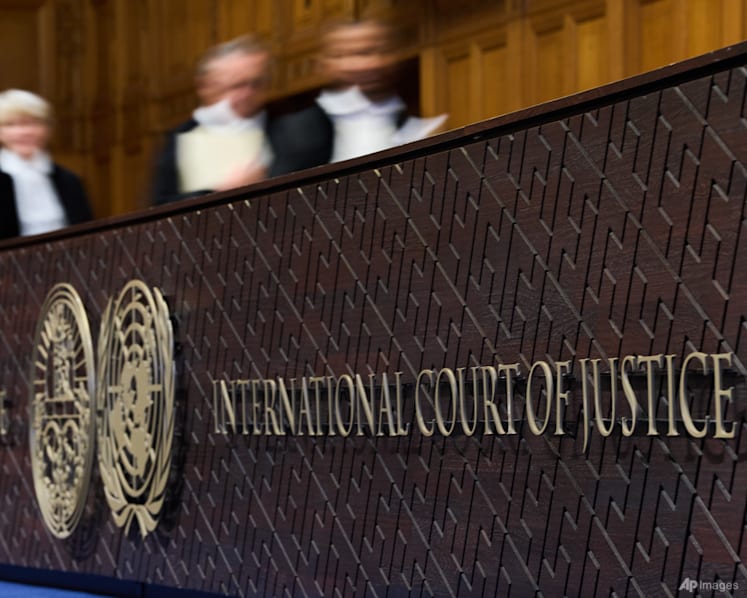 Judges walk to their seats before reading the advisory opinion of the International Court of Justice on what Israel must do to ensure humanitarian aid reaches Palestinians in Gaza and the occupied West Bank, in The Hague, Netherlands, on Oct 22, 2025. (AP Photo/Peter Dejong, file)
Why does it matter for a Singaporean to be a World Court judge?
For a start, having a national representative on the World Court bench does not mean that ICJ rulings will be skewed in the nation’s favour – they are neither delegates or advocates for individual countries as established by institutional design and legal practice.
According to the ICJ Statute, which governs how the court functions, every judge must make a solemn declaration to act “impartially and conscientiously”.
While judges are bound by impartiality, experts said representation on the bench is reflective of the ICJ’s broader institutional legitimacy.
After all, Article 9 of the statute states that the 15-member body, as a whole, is meant to represent “the main forms of civilisation and of the principal legal systems of the world”.
Yet, the entire region of Southeast Asia is historically underrepresented on the court, with only former Philippines Chief Justice Cesar Fernando Cabrera Bengzon serving in the ICJ from 1967 to 1976.
Such a severe lack of regional representation makes it a significant achievement should Ms Lee win the vote, especially given the upward trajectory of the Association of Southeast Asian Nations (ASEAN) as an international organisation and regional economic hub, said Assoc Prof Proulx.
“Second, such a nomination aims at enhancing diversity of small states and island states on the ICJ’s bench.
"If elected to the ICJ, Ambassador Rena Lee would thus be the first female judge hailing from Southeast Asia and from an island or small State," said Assoc Prof Proulx.
Out of all elected ICJ judges who have served since the World Court began its work in 1946, only 20 came from small states.
For instance, previous judges from small states include Patrick Robinson of Jamaica, Julia Sebutinde of Uganda and Abdulqawi Yusuf of Somalia.
A successful election for Singapore’s candidate will be symbolic in cementing Singapore’s record in championing the rule of law and highlighting its commitment to international institutions, said Assoc Prof Proulx.
It would also bolster its ongoing support of international law and peaceful dispute settlement in “a more direct fashion”, including contributions to the development of international law jurisprudence, he added.
Doing so would mean that Singapore is directly enhancing “the consistency, stability, and predictability of international law”, he said.
 The flag of the United Nations flutters during the United Nations General Assembly (UNGA) at the UN headquarters in New York, US, on Sep 21, 2026. (Photo: Justin Tang/The Canadian Press via AP)
How are candidates nominated?
While each of the 15 judges are elected for a nine-year term, not all will end their terms at the same time as the elections are staggered, said senior lecturer Michael Ng from the School of Law at the Singapore University of Social Sciences.
Five seats come up for election every three years, with judges whose terms are expiring allowed to seek re-election, Mr Ng said.
Before the election swings around, countries begin the nomination process to find the most suitable candidate to be put up.
The process is a complex one, said Mr Ng, as the state cannot directly nominate candidates.
Instead, each country has a “national group” - of up to four people who are senior jurists or legal experts - which nominates potential ICJ candidates to the UN.
Each national group can nominate up to four candidates, no more than two of whom may be of its own nationality.
When a candidate who has already been nominated is also nominated by national groups from other countries, these additional nominations are commonly referred to as "co-nominations".
In this year's election, the United Kingdom’s Dapo Akande received 43 national-group nominations, followed by France’s François Alabrune with 40, Singapore’s Ms Lee with 33, Kenya’s Phoebe Okowa with 26, and South Korea’s Jin-Hyun Paik with 21.
According to publicly available UN documents, Ms Lee’s co-nominations span all five UN regional groupings: the Asia-Pacific Group, the African Group, the Latin American and Caribbean Group, the Western European and Others Group, and the Eastern European Group.
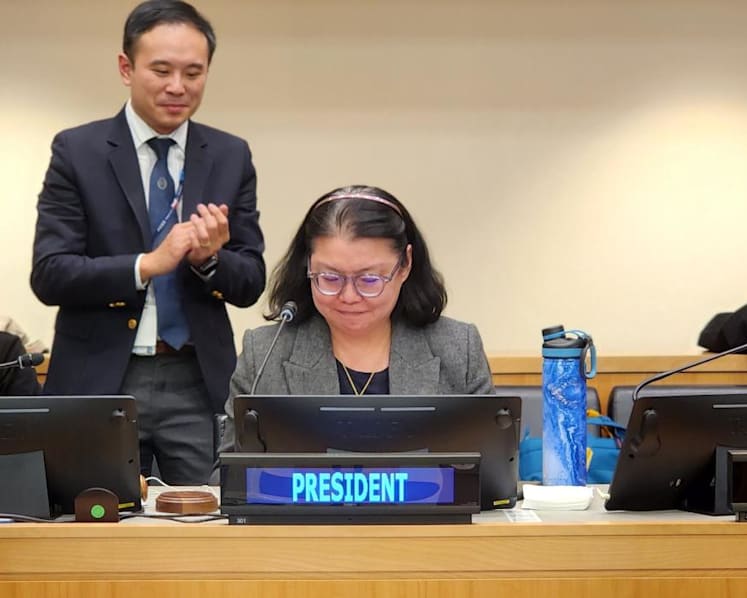 Singapore’s Rena Lee presiding over the Intergovernmental Conference on Biodiversity Beyond National Jurisdiction (BBNJ) and being congratulated for the successful conclusion of the BBNJ treaty. (Photo: Ministry of Foreign Affairs, Singapore)
Who is Rena Lee and is she what UN member states are looking for?
As Singapore’s oceans ambassador from 2018 to 2023, she successfully concluded negotiations on a new global agreement under the United Nations Convention on the Law of the Sea on the conservation and sustainable use of marine biodiversity in areas beyond national jurisdiction.
She was then appointed Singapore’s Ambassador for International Law, a role she still serves, after spending more than three decades working in international law, diplomacy and government.
For her efforts at the global high seas treaty talks, Time Magazine named her in its 100 most influential people of 2024.
Law Minister Edwin Tong said in his Oct 29 address to the UNGA that Ms Lee is an "eminently qualified" international law practitioner, government legal advisor and diplomat, with expertise in the law of the sea, climate and environmental law, humanitarian law and human rights.
Will this list of credentials and accolades appeal to the UN electors, given her career as a diplomat and negotiator but not as a judge?
To this, Assoc Prof Proulx said experience as a government legal adviser, representing a state before international tribunals or the UN, or participating in international law-making conferences, are all relevant.
Under Article 2 of the ICJ Statute, voters should look for judges who are independent and of "high moral character" and who either have the qualifications required for appointment to the highest judicial offices in their respective countries or are recognised experts in international law.
In practice, countries consider a candidate’s legal credentials, professional reputation and experience when deciding how to vote, Assoc Prof Proulx said.
“The candidates’ curriculum vitae are studied meticulously to ascertain a candidate’s expertise in, and experience with the practice of, international law,” he said.
As for who else is in the running, there are nine other candidates from other countries standing for elections
Assoc Prof Proulx noted that while regional representation is an established practice in electing the court's judges, a single seat is expected to be filled by a candidate from the Asia Pacific region.