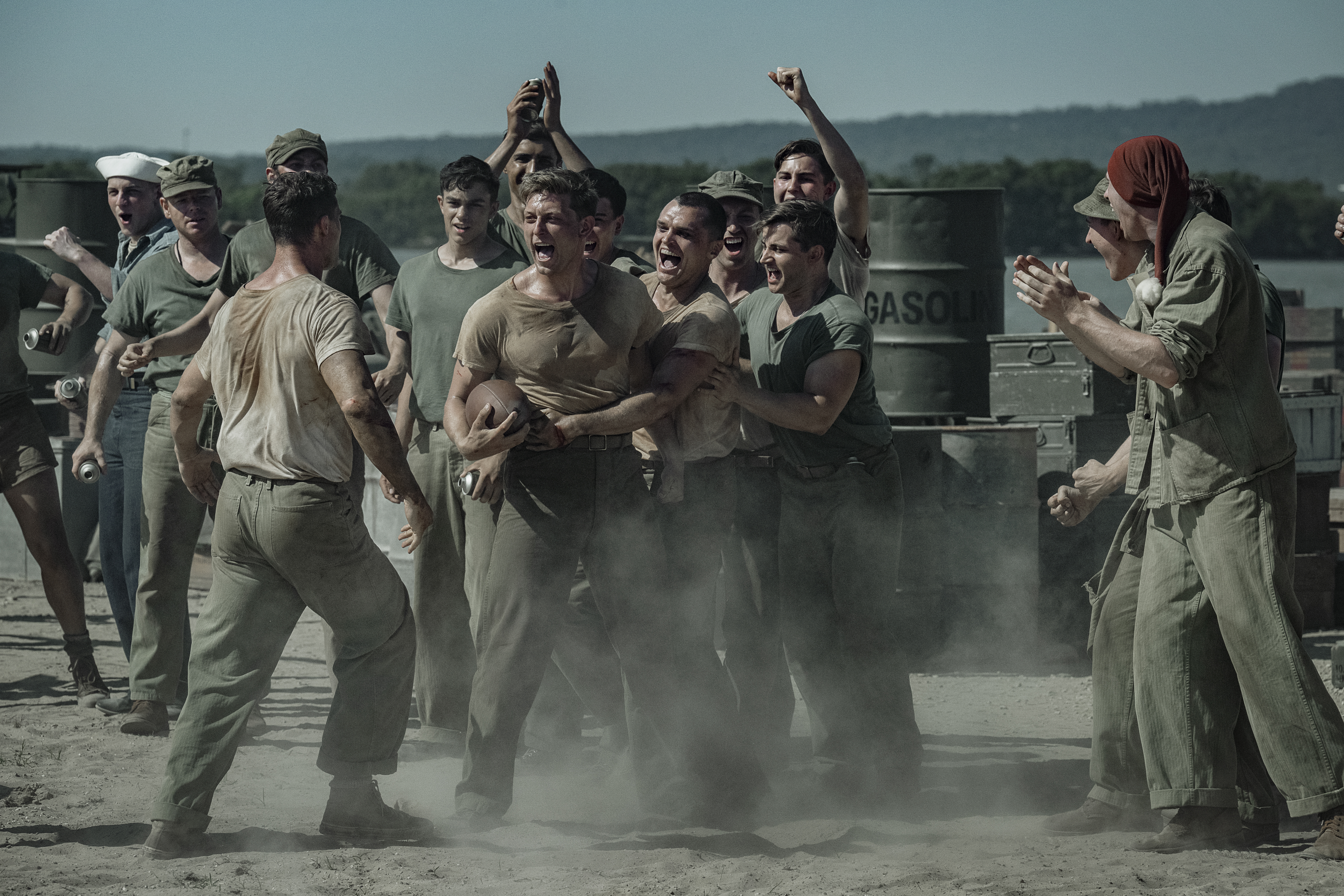
 Tom Francis as Dave Schreiner and Ray Nicholson as Tony Butkovich in The Mosquito Bowl —Kane Skennar/Netflix
In the wet heat of a Guadalcanal afternoon on Christmas Eve 1944, two regiments of the 6th Marine Division met on a football field of packed earth and broken coral. They had come to settle a question argued over beer: Which of them had the better team? The island where the Pacific War’s first major American offensive was fought had been quiet for nearly two years, a staging ground of tents and supply depots where men trained and waited and swatted at the insects that gave the island’s Armed Forces Radio network its name. The game was a serious to-do: There were printed programs, numbered T-shirts, goalposts the Marines built themselves, and an announcer whose call went out over the Mosquito Network to men on ships and islands across the Pacific. At least 1,500 Marines lined the field, some with money on the outcome. Neither team scored. Three months later, the division sailed for Okinawa, an island on Japan’s doorstep, where 15 of the 65 men who played that day were killed.
That game is the short reprieve at the heart of Peter Berg’s The Mosquito Bowl, in select theaters Oct. 30 and arriving Nov. 25 on Netflix. Directed by Berg, who wrote the screenplay with Mark L. Smith, the film adapts Pulitzer Prize-winning journalist Buzz Bissinger’s book and follows four of those players from the Saturday afternoons when the best of their lives still seemed to lie ahead, through weeks of training that could not prepare them for what came next, to one of the bloodiest battles of World War II. Nicholas Galitzine plays John McLaughry, alongside Tom Francis as Dave Schreiner, Bill Skarsgård as Bob Bauman, and Ray Nicholson as Tony Butkovich. Three of those men would die on Okinawa. The fourth would live to 90.
The stadiums give way to boot camp, boot camp to the reef at Tarawa, Tarawa to the long crossing toward Okinawa, where the familiar idea of victory becomes a contest with no whistle, no clock, and survival as the only trophy. What the film is after, once the pageantry is stripped away, is that moment of recognition: young men who thought they had been sent to win learning what they have really been sent to do.
Berg has made films (and a massively popular TV show) about football and films about war. Here the same young men must do both. “They got out there and very quickly found that it wasn’t a game,” Berg tells TIME. “They weren’t really qualified for it, but they were going to do their very best. The tragedy is the death of that innocence.”
The lives before the uniforms
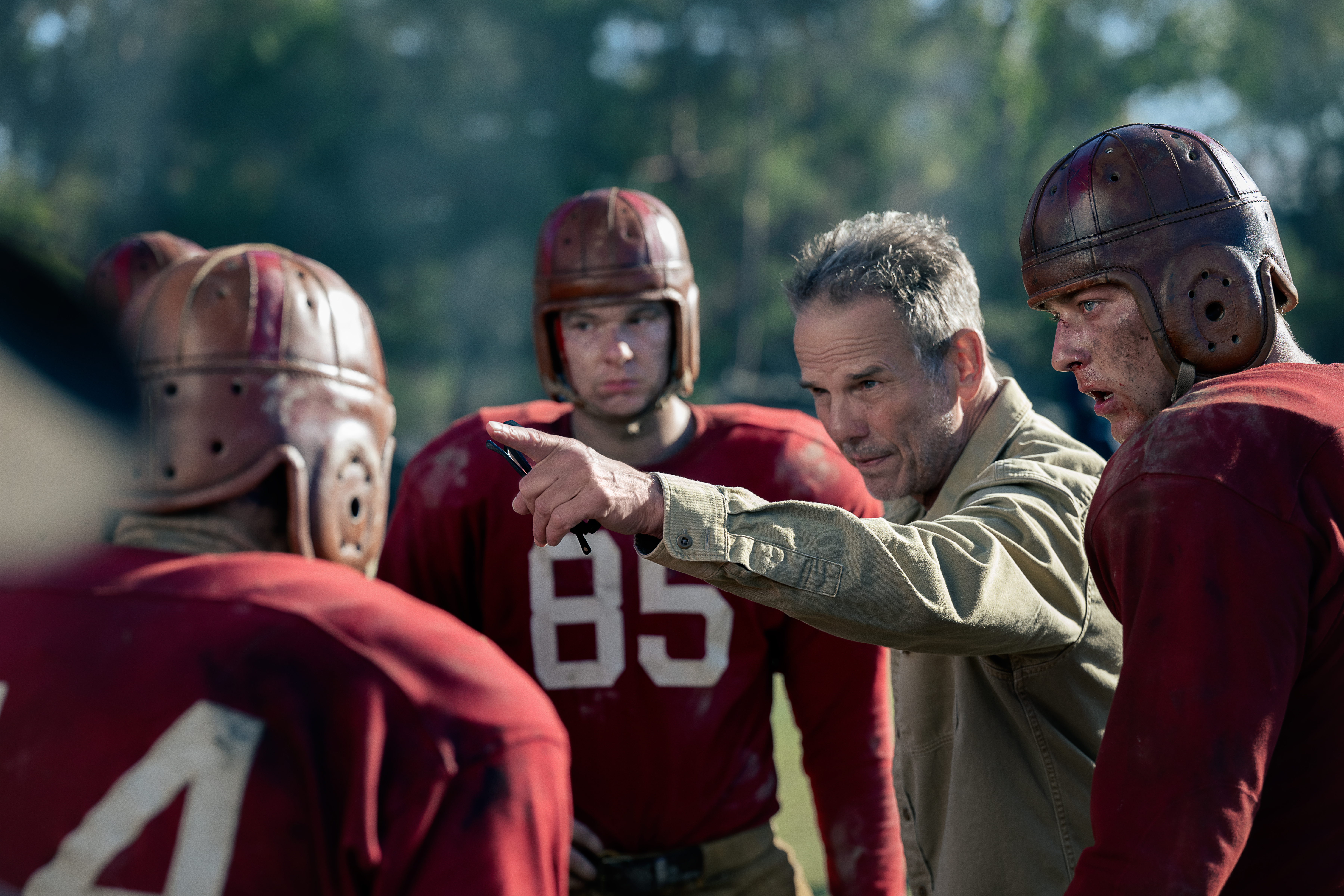 Director Pete Berg on the set of The Mosquito Bowl —Netflix
What the four men shared, after Japan attacked Pearl Harbor on Dec. 7, 1941, was an assumption. Their country had been attacked, and young men like them were expected to go to war.
Schreiner, from Lancaster, Wisconsin, had twice been named an All-American in his career with the University of Wisconsin; in 1942 he was named the Big Ten’s most valuable player, and the Detroit Lions drafted him. The letters he left behind, now at the Wisconsin Historical Society, show a more private side of the star athlete. He was engaged to Odette Hendrickson, wrote to her and to his parents constantly and judged himself without mercy. “Tightly, tightly woven,” Bissinger says of the man. Francis found in him a care and a vulnerability that colored everything, and a mind that would not rest. “He overthinks everything, but then as soon as one of his brothers comes to him and isn’t quite there, he just can find a way to be like, ‘I’ve got you,’” the actor says.
Schreiner had options. “Dave could have gotten out of it because of who he was,” Bissinger says. “He could have easily been a phys ed instructor somewhere at one of the bases in the United States, and he said, ‘No, I got to go. My friends are going. I’m just sitting around doing nothing, and I can’t live with that.’”
The man who kept Schreiner loose was his teammate Bob Bauman, a tackle from Harvey, Ill. Bauman’s father died when he was a boy, and he grew up holding his family together. “Bob was more happy-go-lucky,” Bissinger says. When Schreiner tightened up, Bauman’s advice, as the author renders it, came down to a single line: “Dave, don’t overthink, Dave.” The two enlisted within months of each other and would serve in the same company.
Butkovich was the son of Croatian immigrants who settled in a coal town in central Illinois. He played two seasons at Illinois before the Marines sent him to Purdue, where he rushed for 833 yards in seven games in 1943. The team went undefeated, but the Marines called him away before the season ended, and he cried in the locker room over having to go. The Cleveland Rams made him a first-round pick in 1944, and he kept up a pen-pal correspondence with a 9-year-old fan. “He was really on this high level,” says Nicholson of Butkovich’s stature as a football star. “But at the same time, he was a mama’s boy.”
The oldest of the four, McLaughry was the only one already out of college. His father, Tuss McLaughry, coached at Brown, and John captained his father’s team in 1939 before playing a season for the New York Giants. He also painted. “Steady, solid, almost a Renaissance man,” Bissinger says. Galitzine was drawn to both McLaughry’s intellect and his artistic sensibility. He and Berg discussed McLaughry’s “ability to intellectualize things and how that kind of dissipates, given the trauma and the grotesque violence that he sees,” the actor recalls. What remains is a sense of duty more immediate than politics. “The loyalty you have really is not even to your nation necessarily, or to the men who send you to war, but it’s to your brothers who are in the foxhole next to you,” Galitzine says.
By the autumn of 1944, the war had brought all four to Guadalcanal. Though the film has them all in the same regiment, in reality, Schreiner, Bauman, and McLaughry were officers in the 4th Marines, and Butkovich served in the 29th, the other regiment on the field that Christmas Eve.
The game they made for themselves
 Nicholas Galitzine as John McLaughry —Kane Skennar/Netflix
Bissinger first learned of the Mosquito Bowl by chance, through a passing mention he found while working on another book. “It sounded ludicrous to me and totally unimaginable,” he says. A program survived, with both teams’ rosters, and then he learned that all but one of the men on them had since died. The lives behind those names emerged from what their families had kept: letters, report cards, pictures drawn in childhood.
The game stemmed from an argument. The former college players in the 29th were sure they could beat the former college players in the 4th. The rosters held three All-Americans, seven former captains, and close to 20 men who had been drafted by NFL teams or would go on to play in the league. By December, the regiments had drilled for months, and the drilling had gone stale; men were getting antsy, Bissinger says, and antsy men “get this thousand-yard stare.” The division’s commander, Major General Lemuel Shepherd, was looking for a way to lift their spirits. “When morale flags, Marines get worried,” Bissinger explains, reconstructing the general’s reasoning. “They preoccupy themselves with death, and we need some diversion.” Shepherd approved the game, and the Marines worked hard to make it resemble the real thing. “This was about joy,” Bissinger says. “It was about doing something that they loved, that for many of them would be the last thing they would ever do that they loved.”
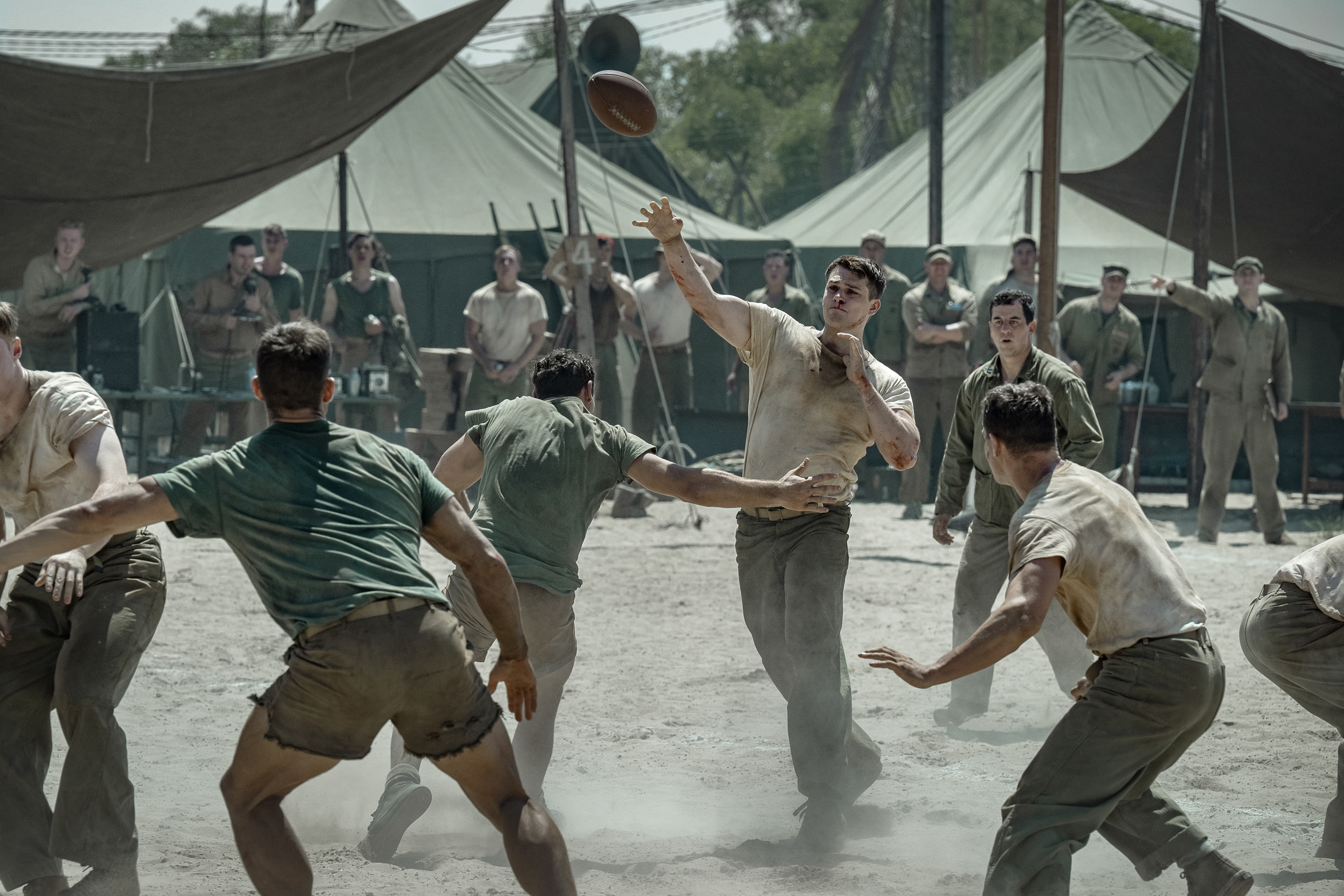
Little of the game itself survives: the date, the printed program, a few photographs, and a final score of 0-0. The men wore T-shirts and cut-off dungarees. Nobody stuck to the intended mode of touch football for long, and the coral in the dirt drew blood. What matters about the Mosquito Bowl is not anything that happened on the field but that it happened at all, an afternoon in which the war paused and these men got to be what they had been raised to be. “The football of it all never really mattered. I think it wasn’t about who scored what, what tackle here, who had this many rushing yards,” Berg says. “It must have given them an opportunity in the middle of this descent into hell to stop, to get out of hell, to be free again, to be young again, and just play a game. That’s what kind of hooked me on Buzz’s book, and that’s what we tried to recreate.”
In the film, the game plays as a respite, beautiful and painful at once: everything they get back is exactly what the war will take. Most of the plays are lost, and Berg is untroubled by it. “I don’t even know what the score of the game is in our movie. I truly don’t know,” he says. “You ask me who won. I don’t know. Was it a tie? I think so. Did they have fun? Yes.”
There would be no rematch. On March 15, 1945, the division sailed from Guadalcanal, by way of the Navy anchorage at Ulithi, for Okinawa.
What Okinawa took
 Nicholas Galitzine as John McLaughry and Ray Nicholson as Tony Butkovich —Kane Skennar/Netflix
On the morning of April 1, 1945, Easter Sunday, the Americans came ashore on the western beaches of Okinawa, 350 miles south of mainland Japan, in the largest landing of the Pacific War. The defenders did not meet them at the beaches; they had dug into the ridges and limestone caves of the island’s southern third and waited. The 6th Marine Division swept north, cleared the island’s northern reaches in three weeks, then turned around and marched south.
The rains came in late May, and for days they did not stop. The roads dissolved, supplies went forward on men’s backs, and the wounded came back the same way. The terraced hills were cut with caves and family tombs the Japanese had turned into firing positions, so that an advance of a few hundred yards could last an entire day of sealing holes with dynamite and flame. Civilians hid in the same caves the soldiers fought from, and many died in them too. By late June, more than 12,000 Americans were dead or missing and nearly three times as many wounded. The Japanese defenders, told not to surrender, mostly did not. The Okinawans are the ones no one can count; estimates of the civilian dead run from about 94,000 to more than 140,000. The Cornerstone of Peace at the island’s southern tip carries more than 240,000 names, soldiers and civilians from every side, and names are still being added.
The worst of it came at a hill the Marines called Sugar Loaf. It stood only some 50 feet high, but it sat between the division and Naha, the island’s capital, and Japanese guns covered it from three directions. It changed hands again and again, and in the 10 days before the Marines finally held it, on May 18, more than 2,600 men from the division were killed or wounded. Three days before the hill fell, George Murphy, the former captain of Notre Dame, who had played in the Mosquito Bowl the previous Christmas Eve, was leading a platoon of the 29th Marines on its slopes.
As Bissinger tells it, Murphy was ordered to make another assault and protested. “We don’t have enough hand grenades,” he said. He would fight for his country, but this was a death assignment. “The captain said, ‘I don’t give a sh-t. You got to go up there,’” Bissinger says. The Army’s official history of the campaign tells it slightly differently. In that version, it was Murphy who asked to fall back and his captain who refused: the hill was to be held, whatever the cost. Murphy brought his men down anyway, through the mortar smoke. He stopped for one of the wounded on the way, and a fragment killed him there. Only 11 of his platoon’s 60 men were left. Bissinger, who refused to soften the book’s combat, puts it plainly: “War is not about glory. War is not about heroism. War is about death.”