- Why has Brazil produced a fossil-fuel ‘roadmap’?
- What does the fossil-fuel roadmap say?
- How will the fossil-fuel roadmap be discussed at COP31?
Transitioning away from fossil fuels is “urgent, inevitable and, yet, possible”, according to a first-of-its-kind global “roadmap” produced by Brazil.
The host of last year’s climate summit, COP30, has set out a voluntary plan for how countries can move away from coal, oil and gas.
The roadmap says there is no “one-size-fits-all” approach to transitioning away from fossil fuels and asks countries to “diagnose” their own “readiness” to start the process.
After mapping out their specific circumstances, countries should then pursue “tailored levers” to take action, according to the roadmap.
These efforts should culminate by 2033, it says – 10 years on from when the COP28 climate summit in Dubai called on all countries to contribute to a global transition away from fossil fuels.
Below, Carbon Brief examines what the roadmap says and how it could influence debates about fossil fuels at the upcoming COP31 climate summit, which begins next week in Turkey.
- Why has Brazil produced a fossil-fuel ‘roadmap’?
- What does the fossil-fuel roadmap say?
- How will the fossil-fuel roadmap be discussed at COP31?
Why has Brazil produced a fossil-fuel ‘roadmap’?
Calls for a global “roadmap” away from fossil fuels dominated debates at COP30, which was held in the Amazonian city of Belém.
A group of 85 countries called for a reference to a new roadmap for transitioning away from fossil fuels to be part of COP30’s formal negotiated outcome.
This call came the first “global stocktake” of action towards the world’s climate goals at COP28 in 2023 called on all countries to contribute to transitioning away from fossil fuels.
However, another group of countries opposed such an inclusion.
It was claimed that this group included 84 countries. However, Carbon Brief’s analysis of the “informal list” revealed inconsistencies and errors, meaning the total number of countries opposing the roadmap was likely smaller.
After two weeks of fierce debate, Brazil announced that the fossil-fuel roadmap would not be part of COP30’s negotiated outcome – but that the presidency would work to create a roadmap outside of the UN climate process.
This roadmap is voluntary and countries are not obligated to respond to its findings.

Membership
Support award-winning climate journalism
Join CB+At COP30, the presidency also announced that the roadmap would be informed by a first-of-its-kind conference on transitioning away from fossil fuels taking place in Santa Marta, Colombia.
These talks, co-hosted by Colombia and the Netherlands in April, saw ministers and climate envoys take part in informal discussions about the barriers they face in transitioning away from fossil fuels. (See Carbon Brief’s full coverage of the talks.)
As well as the fossil-fuel roadmap, Brazil has also produced a new roadmap for ending deforestation. (See Carbon Brief’s in-depth breakdown of the deforestation roadmap).
What does the fossil-fuel roadmap say?
The roadmap acknowledges that, after decades of delayed action on fossil fuels, the world is no longer able to meet its ambition to limit global warming to 1.5C without first “overshooting” the target.
It also notes that the global transition to clean energy is already underway – and that the policies needed for transitioning away from fossil fuels already exist and are readily deployable.
It continues, however, by saying that transitioning away from fossil fuels is “as much a development question as a climate one, especially for emerging markets and developing economies”.
In this context, it sets out plans for what it calls a “Belém readiness index”. This is a “voluntary self-assessment tool” that countries can use to calculate their dependency on fossil fuels and their capacity for transitioning away.
At a press briefing announcing the roadmaps, COP30 CEO Ana Toni described this as the “diagnosis” stage of the roadmap, “instead of imagining there is a one-size-fits-all answer”.
After identifying their “readiness” for transition, countries will be sorted into four “archetypes”, says the roadmap, leading to the identification of specific policy “levers” for taking action.
The roadmap calls for action in three distinct “phases”.
The first phase should be from now until 2028, when the second global stocktake of progress towards the Paris Agreement is due to conclude at COP33.
In this phase, “efforts focus on institutions and long-term signals”, says the roadmap.
The second phase is from 2028-2030, when the next round of UN climate pledges, known as nationally determined contributions (NDCs), are due.
This phase should focus on the “physical transformation of energy systems”, says the roadmap.
The final phase is 2031-2033 – 10 years after the call for all countries to help with “transitioning away from fossil fuels” in “this critical decade” at COP28.
This phase should focus on the scaling up of the transition, according to the roadmap.
All of these elements are summarised in the graphic below, which was presented to journalists and civil society during a press briefing.
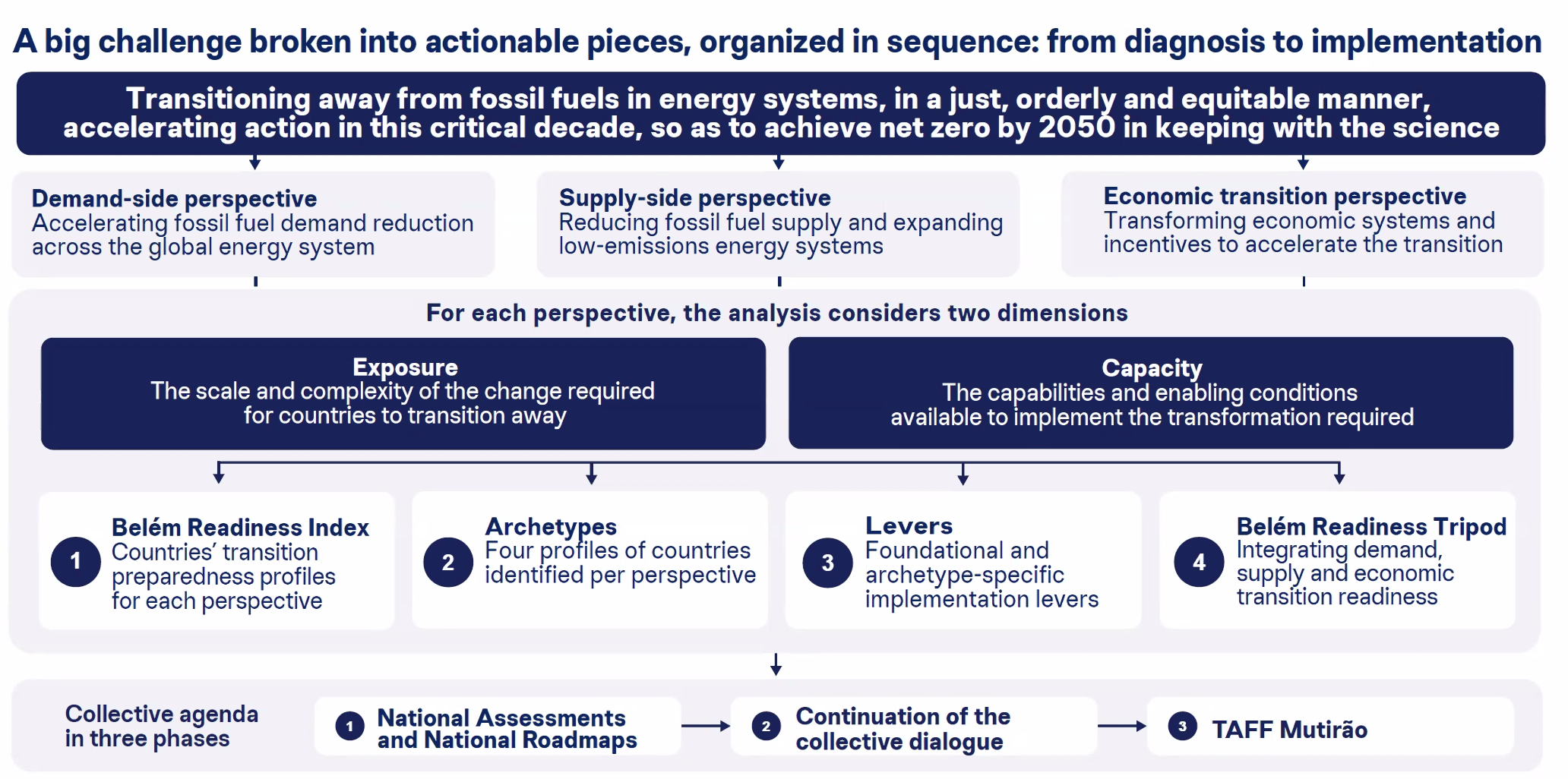 Credit: COP30 presidency
At the press briefing, Toni added that each stage of the roadmap was designed to be “extremely pragmatic and easy for countries to take a look at it”.
The approach has broadly been welcomed by civil society and experts.
Dr Natalie Jones, a senior policy adviser at the International Institute for Sustainable Development (IISD), tells Carbon Brief that the roadmap sends an “important political signal that the transition away from fossil fuels remains firmly on the international agenda”. She adds:
“It also gives governments practical guidance to plan that transition in ways that reflect their national circumstances, strengthen energy security and protect livelihoods.”
Avantika Goswami, a climate policy expert at the Centre for Science and Environment in New Delhi, India, tells Carbon Brief that the roadmap is a “unique and consultative method of multilateralism”. She says:
“[The roadmap] is one that is put forth by a developing country, via a consultative process that invited submissions from all parties and civil society.
“The analytical framework proposed captures the complexity of the fossil-fuel transition. Countries must now use it to chart out pathways in line with their historical responsibility and current capacity.”
Ploy Achakulwisut, a former UN adviser on fossil fuels, wrote on LinkedIn that she was “deeply impressed” with Brazil’s approach, including its use of a “readiness index”. She added:
“[The index] provides a method for identifying countries that face similar transition conditions and for understanding how different exposure-capacity ‘archetypes’ can generate distinct implementation needs and opportunities.
“The latter can ‘support more targeted international cooperation’, helping the international community to align finance, technology, capacity-building, and technical assistance with country-specific needs and existing capabilities.”
How will the fossil-fuel roadmap be discussed at COP31?
Brazil’s fossil-fuel roadmap comes just a week before the next round of UN climate talks, COP31, kicks off in Antalya, Turkey.
COP31 co-presidents Turkey and Australia have set out a wide range of priorities for the summit, including a target to increase the share of global final energy consumption met by electricity from almost 24% in 2023 to 35% by 2035.
Speaking at the press briefing, COP30 president André Aranha Corrêa do Lago said that this electrification goal was “complementary” to the aims of the fossil-fuel roadmap.
Carbon Brief understands that some parties feel that Turkey and Australia’s focus on electrification over fossil fuels is an attempt to avoid a re-hashing of the lengthy debates at COP30.
Both Corrêa do Lago and Toni were reluctant to speculate on how the fossil-fuel roadmap might be taken up and discussed during COP31, with Toni telling journalists that they were “hoping for the best”.
When asked about how Brazil hoped the roadmap would be received by those that specifically opposed its inclusion at COP30, Corrêa do Lago declined to address other countries directly, but said:
“Let’s remind ourselves we already have a consensus [on transitioning away from fossil fuels, agreed at COP28] and we already have the instruments.”
Jones tells Carbon Brief that, following on from the roadmap, the “task now is to build on that signal with action”, adding:
“At COP31, more governments should announce national fossil-fuel transition roadmaps and explain how these will inform their national climate plans. The conference should also [formally] recognise the global roadmap and establish a route for its findings to inform the second global stocktake.
“For vulnerable countries dependent on fossil-fuel revenues, credible plans must be matched by international finance and support to diversify their economies and sustain public services. This roadmap can help turn a shared commitment into practical progress.”
Related
Interactive: Who wants what at the COP31 climate change summit
02.11.2026 COP31 Antalya
Experts: What China wants from the COP31 climate talks
29.10.2026 China policy
Interview: COP31 president says electrification is ‘surest way to protect citizens’
10.07.2026 COP31 Antalya
Bonn climate talks: Key outcomes from the June 2026 UN climate conference
19.06.2026 AdaptationThe post Q&A: What is in the global ‘roadmap’ for transitioning away from fossil fuels? appeared first on Carbon Brief.