Russia denies targeting Ukraine's neighbours with drones and says that European governments are the ones escalating the war in Ukraine by supplying military aid.
The fire-damaged "Royad Mammadov" ship in the Black Sea after a fire aboard the vessel outside Romania's territorial waters left two people dead and prompted a rescue operation in which others were rescued, in this handout image released on Oct 5, 2026. (File photo: Reuters via Handout/Romanian Interior Ministry)LONDON/BUCHAREST: After seven strikes on cargo ships near NATO members Romania and Bulgaria last month, the US-led military alliance said it would deploy maritime patrol aircraft, radars and drones to bolster its eastern flank in the Black Sea.
Three days later, on Oct 23, another ship was struck just outside Romanian waters. And last week a Greek container ship was sunk by naval drones in Bulgaria's exclusive economic zone.
Unabating attacks show how the escalating maritime war between Russia and Ukraine is expanding into a major challenge for NATO in the Black Sea that has left littoral member states such as Romania and Bulgaria exposed.
Military analysts said they had little doubt that these were Russian attacks. A naval drone seen on video of the last strike resembled a Russian variant, according to shipping security firm Ambrey.
CNA Games
 Guess Word
Crack the word, one row at a time
 Buzzword
Create words using the given letters
 Mini Sudoku
Tiny puzzle, mighty brain teaser
 Mini Crossword
Small grid, big challenge
 Word Search
Spot as many words as you can
Show More
Show Less
"I think it's undeniably an escalation," said Sidharth Kaushal, a senior fellow at the London-based RUSI think-tank.
Russia denies targeting Ukraine's neighbours with drones and says that European governments are the ones escalating the war in Ukraine by supplying military aid. Russia's defence ministry did not respond to a request for comment for this article.
ANALYST SAYS RUSSIA IS TESTING RED LINES
Many of the ships hit in October were anchored near or sailing to or from a key Romanian canal used by Ukraine for exports. One was in Romanian territorial waters, while the other eight were in its or Bulgaria's exclusive economic zone.
Iulia Joja, director of the Black Sea programme for the Washington-based Middle East Institute think-tank, said Russia's attacks were taking into account the West's aversion to escalation.
"This is about testing these red lines, with full awareness that we will do everything possible to take the most minimal measures," Joja said, drawing a comparison with Russian drone incursions into NATO airspace in recent years.
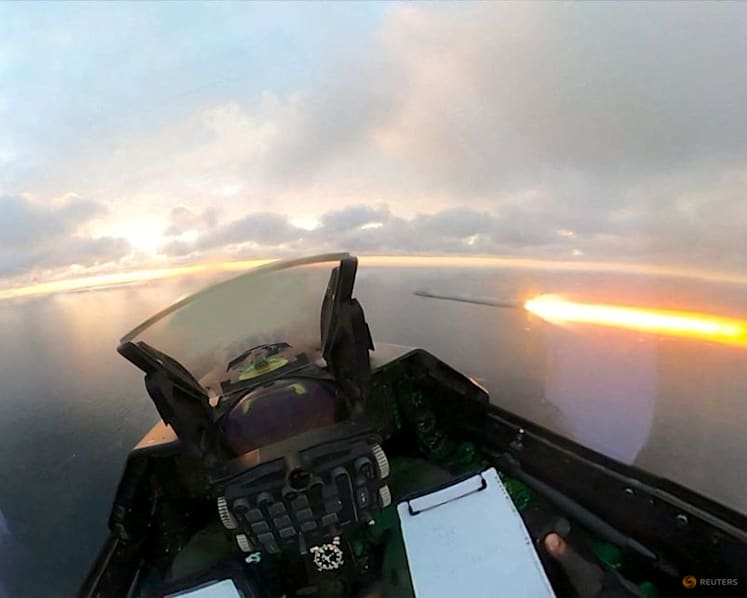 FILE PHOTO: A view from the cockpit of a Romanian F-16 fighter jet during a mission to intercept and neutralise two drones that entered Romanian airspace without authorization on Oct 17, 2026. (File photo: Reuters via Handout/Romanian Defense Ministry)
A NATO official said Russian actions aimed at dissuading NATO allies from supporting Ukraine were a serious security threat and that the alliance's commitment to defending all its members, including those on the Black Sea, was "ironclad".
The official said there was a clear need for cost-effective counter-drone capabilities, but that the alliance had already committed to investing more than US$40 billion in counter-drone capabilities in the next five years.
BLACK SEA IS CRUCIAL WATERWAY
For Romania, the Black Sea is a crucial waterway for trade and home to its offshore Neptun Deep project that will make it the European Union's largest gas producer next year. Neptun Deep was approached by a naval drone in August.
Bucharest has accused Russia of "systematic" strikes on civilian ships but stopped short of attributing individual attacks, citing the need for forensic evidence. Sofia has not blamed Russia, but said some of the attacks seem to benefit it.
The strikes come at a time when Washington is reassessing its military presence in Europe as it focuses on China. The US withdrew 1,000 troops from Romania last year.
"It's a moment in the transatlantic relationship that Putin likely wants to use," said a senior Romanian official. "The EU and NATO's attention is important and their forces are currently focusing towards the north and the Baltics."
While NATO has reinforced its "enhanced forward presence" for the Baltics and Poland, Joja said it had not done the same in Romania despite Bucharest's requests.
"Brussels and Washington still don't seem to have decided whether the Black Sea is fully part of the NATO commitment."
The Romanian official highlighted Romania's pressing need for surface-to-air interceptors and radar systems to counter threats.
Joja said the limited availability of cheap interceptor weapons, exacerbated by the war in Iran, was a central problem for the West.
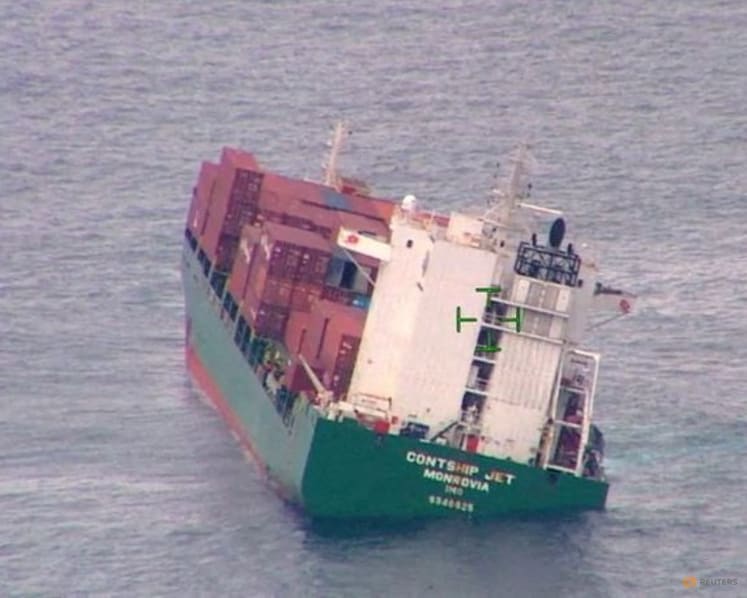 The Liberian-flagged container ship Contship Jet at sea on Oct 28, 2026. The ship sank after being hit by naval drones in the Black Sea off Bulgaria, according to the Bulgarian government, while en route from Haifa in Israel to Constanta in Romania. (File photo: Reuters via Handout/French Armed Forces)
NEARLY 400 VESSELS HIT IN PAST YEAR
The surge in strikes on Black Sea shipping has strangled a major conduit for exports of grain and oil used by Russia and Ukraine.
The two sides hit 317 merchant and other vessels in the Black Sea and Sea of Azov between May and October, a more than fourfold rise on the 74 vessels they struck in the previous half-year, according to Tomas Alexa, a senior analyst at Ambrey Analytics.
The tempo of attacks has fluctuated ahead of the fifth anniversary of Russia's full-scale invasion in February.
Ukraine carried out 137 attacks on ships compared with 92 Russian ones in the third quarter, while in October, Russia hit 38 compared with 5 Ukrainian strikes, Ambrey said.
GRAIN EXPORTS FROM UKRAINE AND RUSSIA SLUMP
Ports have been battered and exports have shrivelled, forcing Russia and Ukraine to seek alternative export routes.
Russia exported just 0.3 million metric tons of grain in September through the Black Sea and Sea of Azov, down from 4.74 million metric tons in the same month last year, according to Russian export data seen by Reuters.
Ukraine suspended operations at its Black Sea ports in late July due to Russian attacks, prompting it to divert volumes to river ports on the Danube and onwards through Romania's Sulina Canal and southwards through Romania's section of the Black Sea.
Even with this alternative route, Ukraine's port exports of grain slumped to 0.81 million metric tons in September compared with 2.1 million in September last year, government data showed.
Further reducing these volumes remains Russia's primary goal with testing NATO as the secondary objective, said Andriy Ryzhenko, a naval analyst and former senior Ukrainian naval officer.
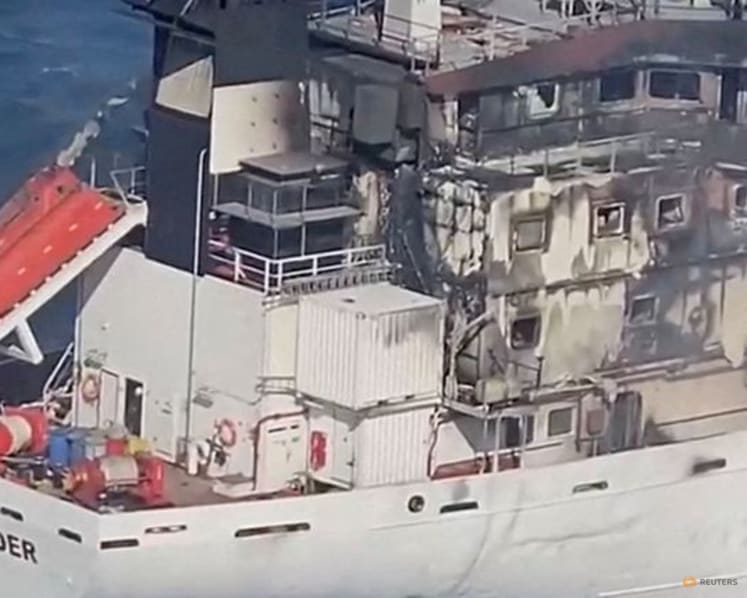 A screengrab from an aerial footage shows San Marino-flagged tanker wine trader ship that caught fire in Romanian territorial waters, released on Oct 15, 2026. (File photo: Reuters via Handout/Romanian Interior Ministry)
ZELENSKYY WARNS OF FOOD CRISIS
Last week's attack took place as the defence ministers and military chiefs of Romania, Bulgaria and fellow NATO littoral state Turkey met in Sofia to discuss the situation.
The defence minister of Turkey, which is waiting for a response from Moscow and Kyiv on a narrow maritime ceasefire proposal, used the meeting to warn Russia and Ukraine against further attacks.
Turkey controls the transit of warships through the Bosphorus and Dardanelles under the Montreux Convention.
Several countries, including Egypt, Turkey and India, have pushed for maritime ceasefires to avert fallout from the disruption of shipping at a time when global fuel and grain prices have soared.
US Secretary of State Marco Rubio said on Saturday there was growing international interest in a limited ceasefire.
Russia has rejected the idea of a narrow maritime ceasefire that it says would provide respite to Kyiv. Ukrainian President Volodymyr Zelenskyy has sounded the alarm.
"Everyone is talking about diesel and forgetting about grain. In a month or two, everyone will start talking about an agricultural crisis," he said last month.