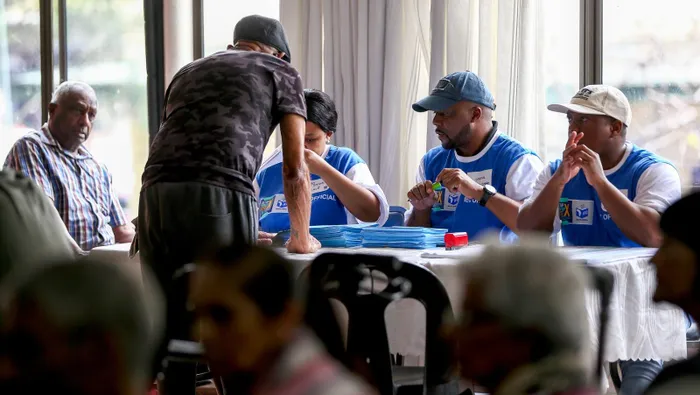
Special Voting commenced on Monday, November 2, 2026 in the Local Government Elections. The Electoral Commission of South Africa (IEC) approved a record 2,655,067 special-vote applications, representing a 131% increase compared with the 1,147,759 approved for the 2021 municipal elections. Special voting continues on Tuesday, November 3.
As South Africa approaches another round of local government elections, politicians are once again descending on impoverished communities with promises of jobs, housing, water, electricity and better services. Every aspiring councillor appears to possess the answers to problems that have persisted through more than three decades of democratic government.
Yet amid these familiar promises, one of the most significant developments in our democracy receives remarkably little attention: increasing numbers of South Africans are no longer participating in elections.
In the 2016 local government elections, approximately 58% of registered voters cast their ballots. By 2021, that figure had fallen to just 45.86%, representing only about 31% of all voting-age South Africans. The 2024 national elections offered little reassurance. Although official turnout was 58.64% of registered voters, only about 41% of eligible citizens actually voted. In other words, almost six out of every ten eligible South Africans did not take part in choosing their national government. These figures suggest a deepening crisis of electoral participation that cannot simply be dismissed as voter apathy.
We cannot assume that everyone who abstains does so for the same reasons. Some are disillusioned, others face practical obstacles, and some may simply believe their participation makes little difference. But after decades of working alongside marginalised and excluded communities, I have come to believe that something more fundamental is happening.
What if millions of South Africans are not rejecting democracy, but losing faith in a political system that asks them to surrender their power to a few hundred representatives, only to discover that they have little meaningful influence over the decisions subsequently made in their name?
The crisis confronting South Africa is not simply declining electoral participation. It is representative democracy becoming increasingly disconnected from the popular power on which its legitimacy and survival depend.
We fought so that the people would govern
I became involved in politics at the age of 14, when the struggle against apartheid demanded enormous sacrifices, including from children who should have been enjoying their youth rather than confronting the violence of an oppressive state.
We were not fighting merely to exchange white politicians for black politicians, or to elect a new ruling class every five years. We believed we were fighting for a society in which ordinary people would exercise meaningful power over the decisions governing their lives.
The street committees, area committees, civic associations and other democratic structures that emerged during the struggle were not simply instruments of resistance. They represented an alternative vision of democracy, in which organised communities could deliberate, make collective decisions and hold their representatives accountable. This was the meaning we attached to the Freedom Charter’s declaration that the people shall govern.
That democratic aspiration was embedded in our constitutional settlement. Section 152 of the Constitution specifically requires local government to encourage the involvement of communities and community organisations in municipal affairs. The Constitutional Court has repeatedly affirmed that representative and participatory democracy are mutually supportive.
Yet over the three decades since, we have witnessed the progressive concentration of power in political parties, executive offices and bureaucracies increasingly distant from the communities whose lives they govern. Instead of becoming active participants in determining their futures, ordinary people have been reduced to voters, beneficiaries, complainants and occasional participants in consultation exercises whose outcomes they seldom influence.
We were promised popular democracy but have increasingly become spectators in a political system operating in our name.
Marikana and the betrayal of our promise
For me, the final rupture came in August 2012.
When police massacred 34 striking mineworkers at Marikana, the brutality of the state was once again displayed before the nation. Here were working-class men demanding better wages and a fairer share of the wealth their labour produced, confronted by lethal state violence. Whatever complexities surrounded the events preceding that terrible day, nothing could justify the massacre.
For me, Marikana exposed a fundamental contradiction within our democracy: a state born from the struggles of the oppressed had shown its willingness to deploy deadly force against impoverished workers confronting powerful economic interests. It represented a profound betrayal of the ideals for which my generation had sacrificed so much.
But this does not mean I have abandoned politics. I have been politically active for most of my life, although I have never considered myself a politician. My experience of professional politics has left me deeply suspicious of those who seek authority over others while proclaiming their commitment to serving them. Too often, I have encountered politicians who regard public office as an entitlement to command rather than an obligation to serve, expecting communities to show loyalty, gratitude and submission in return for benefits that should never depend on political patronage.
In my work with mining-affected communities, I have encountered thousands of ordinary people whose demands are remarkably modest. They want justice, dignity, fairness and a meaningful voice in decisions affecting their land, livelihoods and futures. Yet what they repeatedly encounter is a political and administrative system that regards their participation as an inconvenience rather than a constitutional right.
Mining companies are granted access to the wealth beneath communities’ feet, while residents struggle to influence development commitments supposedly made for their benefit. Public participation processes are reduced to notices, meetings and attendance registers, while the underlying distribution of decision-making power remains unchanged.
Politics is fundamentally concerned with how power and resources are distributed. Yet those responsible for allocating supposedly scarce resources enjoy salaries, allowances and privileges far removed from the deprivation experienced by millions of South Africans. Within this political and economic order, individual advancement, accumulation and patronage increasingly displace the collective aspirations that informed our liberation struggle.
Ordinary people are left competing for crumbs distributed by those who occupy positions of privilege. We have created a democracy in which communities are repeatedly invited to participate in the administration of their own exclusion.
Why are politicians afraid to give communities power?
As another election approaches, I would like every political party to answer one question: why are your manifestos filled with promises about what politicians will do for communities, but contain so little commitment to transferring meaningful decision-making power to communities themselves?
Where are the proposals to give democratically accountable community structures greater authority over development priorities and municipal expenditure? Where are the commitments to participatory budgeting, stronger community oversight and enforceable mechanisms for holding elected representatives accountable between elections?
Instead, we hear the same tired proposition: vote for me and I will deliver this; vote for my party and we will provide that. After three decades, this resembles the sales pitch of a charlatan more than a credible programme for democratic transformation.
The measure of a genuinely democratic political programme should not simply be what its leaders promise to deliver, but how much meaningful power they are prepared to place in the hands of ordinary people.
Some will argue that refusing to vote strengthens the very political forces responsible for our present condition. It is a legitimate objection. Elections matter, and the decisions of elected representatives have real consequences. Nor do I suggest that everyone who shares my dissatisfaction should necessarily follow my decision.
But we must reject the proposition that casting a ballot every five years is the highest expression of democratic responsibility, while the daily struggle to exercise popular power is treated as secondary.
Representative democracy is not inherently opposed to popular democracy. On the contrary, it cannot survive without meaningful popular democracy. When people are reduced to choosing who will govern them, while being systematically excluded from exercising power between elections, democracy progressively loses its substance and legitimacy.
On election day, I will once again be among those who do not vote. But alongside thousands of others organising in marginalised communities, I will continue working to build the collective power through which ordinary people can exercise their constitutional rights.
I did not sacrifice my youth so that ordinary people could exchange one set of rulers for another, or spend their lives begging public officials to listen to them. I fought because I believed in a society in which the people would govern.
The greatest threat to representative democracy is not simply the millions who no longer vote. It is a political establishment that expects the people to surrender their power at the ballot box, rather than exercise it every day.
Democracy will not be saved merely by persuading more people to vote. Its future depends on finally giving practical meaning to the promise that the people shall govern.
Christopher Rutledge is a social justice activist and Executive Director of the MACUA-WAMUA Advice Office.