Thailand is expanding its space ambitions, with plans for a launch facility and efforts to build a domestic satellite industry. But attracting investment and developing commercial demand remain major challenges, experts say.
An inflatable astronaut on display at Thailand Space Expo 2026 on October 28, 2026. (Photo: CNA/Jarupat Karunyaprasit)
An inflatable astronaut on display at Thailand Space Expo 2026 on October 28, 2026. (Photo: CNA/Jarupat Karunyaprasit)



BANGKOK: When Nattaporn Chattam learned that her scientific experiment had gone missing aboard the International Space Station (ISS), she was stunned.
For years, the Thai physicist and her team at Kasetsart University in Bangkok had worked to send a 27kg scientific apparatus into orbit, some 400km above Earth.
It was a milestone for Thailand's emerging space programme. Developed with support from the country's space agency, the experiment was the first Thai national research payload to reach the station under a pioneering agreement with NASA.
The aim of Nattaporn's experiment was to study how liquid crystals, materials commonly used in television and mobile phone screens, behave in microgravity, where the pull of Earth’s gravity is much weaker than on its surface, with potential applications for future electronic and optical technologies, including on the Moon.
CNA Games
 Guess Word
Crack the word, one row at a time
 Buzzword
Create words using the given letters
 Mini Sudoku
Tiny puzzle, mighty brain teaser
 Mini Crossword
Small grid, big challenge
 Word Search
Spot as many words as you can
Show More
Show Less
Astronauts began conducting the experiment aboard the station on behalf of the Thai scientists in December last year. But when the equipment was supposed to return to Earth months later, something went wrong. The critical research was missing.
"We thought it was lost in space. All we got back was some hard drives. I was very stressed," Nattaporn said.
It was later discovered that the experiment had been left behind aboard the ISS instead of being loaded onto the spacecraft returning to Earth. It was eventually recovered, landed in June and was handed back to the researchers last month, several months after its originally scheduled return.
 Nattaporn Chattam, a Thai space scientist, speaks to CNA at Thailand Space Expo 2026. (Photo: CNA/Jarupat Karunyaprasit)
For a country seeking a bigger role in the global space industry, the mission demonstrated what its scientists could achieve, while exposing some of the complications of working far beyond Earth.
"We know our science is good. As good as anyone. So why not us? We proved we can do it," Nattaporn said.
Nattaporn’s experiment is part of a wider push across Southeast Asia to secure a foothold in the growing global space economy, as countries seek new commercial opportunities and greater technological independence amid intensifying competition between major space powers.
It is also part of Thailand's growing push to develop its own space capabilities, an ambition on display at a major international space expo in Bangkok last week (Oct 28 to Oct 31). Inflatable astronauts sat alongside boxed space components and satellite demonstrations, as companies showcased technology ranging from spacecraft hardware to software for monitoring conditions on Earth.
Now, the country is pursuing far bigger ambitions, including plans for its own spaceport and efforts to build a domestic industry capable of manufacturing satellites and other advanced technology.
It is seeking to expand its domestic satellite manufacturing industry and has been studying the possibility of establishing its own spaceport, potentially allowing rockets to be launched from Thai territory.
Pakorn Apaphant, executive director of Thailand’s space agency, the Geo-Informatics and Space Technology Development Agency (GISTDA), said Thailand saw space technology as a way to strengthen its economy and industrial competitiveness.
“Today, space is no longer just about sending people into space,” he told reporters at the expo.
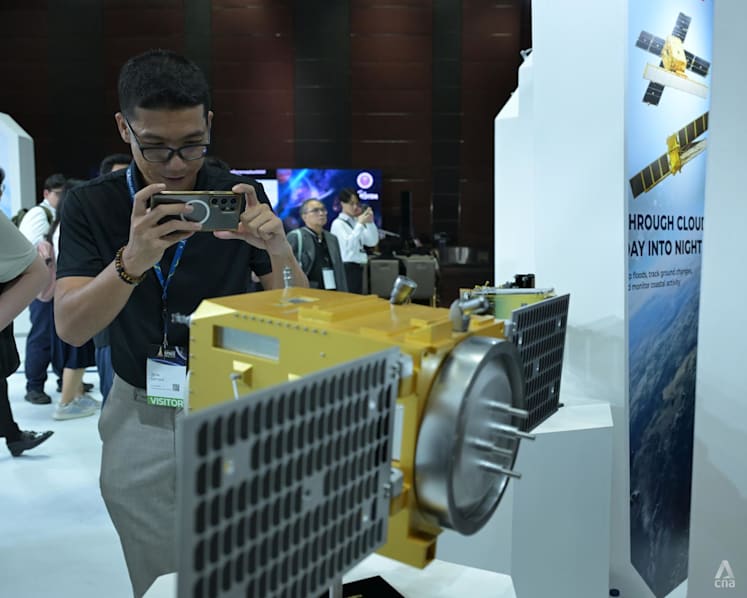 Thailand is keen to increase the value and viability of its broader space industry. (Photo: CNA/Jarupat Karunyaprasit)
Thailand already has experience using satellite data, as well as designing, assembling and testing spacecraft. But developing a sustainable domestic industry will require further investment, technical expertise and commercial demand, he said.
The proposed spaceport remains some way from becoming a reality.
GISTDA has spent several years studying potential locations, safety and environmental requirements and possible business models. It is now working to attract private investment and international technology partners.
There is an initial goal of developing suborbital rocket launch capabilities within five years, according to GISTDA. But officials say a fully operational facility would take at least seven years to build once approved, with financing and regulatory hurdles still to overcome.
"So this doesn't mean that we will be launching rockets from Thailand tomorrow," Pakorn said.
"What we are doing now is creating the conditions that could eventually make a commercially viable spaceport possible."
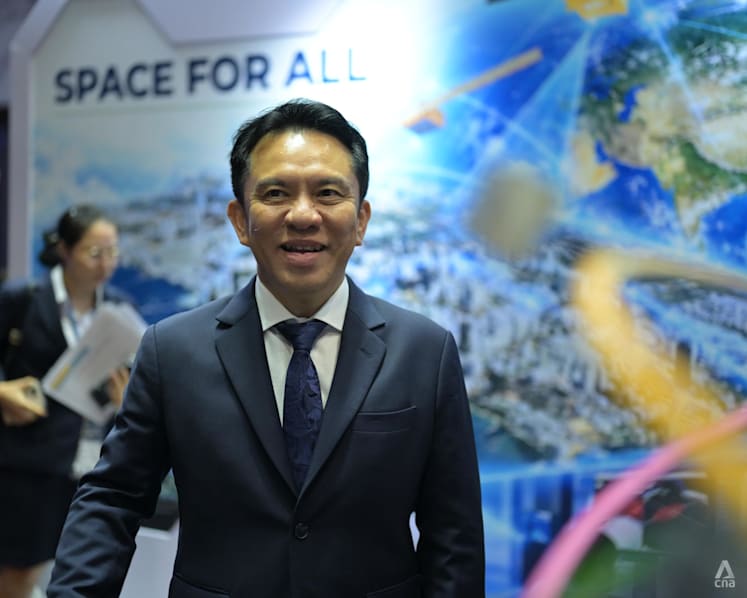 Pakorn Apaphant, executive director of the Geo-Informatics and Space Technology Development Agency (GISTDA). (Photo: CNA/Jarupat Karunyaprasit)
A GIANT ECONOMIC LEAP?
For decades, Thailand has been a regional manufacturing powerhouse across many sectors, including automotive production, electronics and precision engineering.
The government is hoping that transitioning some of that expertise into its nascent space industry will not be a giant leap.
"We don't need to start from zero. What we need to do is raise the standards and capabilities of these companies so they can manufacture components for the space industry," Pakorn said.
Thailand's direct space industry was valued at around 30 billion baht (US$900 million) back in 2019, according to government figures. When wider economic activities supported by space technology were included, the estimated value rose to 500 billion baht.
Thailand's space agency currently operates two Earth observation satellites and has outlined plans to expand its fleet to as many as 18 over the next six to seven years.
Pakorn said Thai companies were already developing components for the country's THEOS-3 satellite programme, including aluminium structures, carbon-fibre parts, solar panels and software. That project is intended to improve Earth observation capabilities, including for agricultural and environmental monitoring.
The longer-term goal is to produce equipment for international customers.
"Thailand has largely been a user of space technology. What we want to do next is move from being a user to becoming a country that can develop its own technology, manufacture components and create its own services," he said.
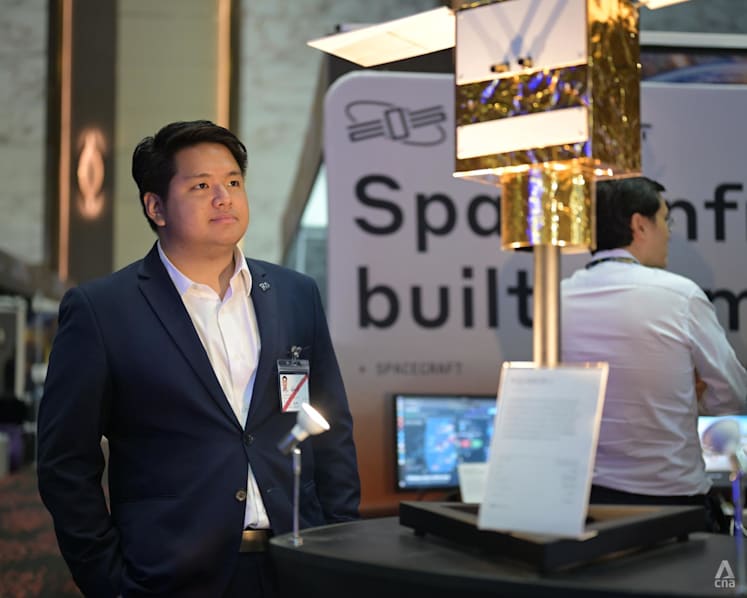 EOS Orbit chief operating officer Passawish Kulchol at Thailand Space Expo 2026. (Photo: CNA/Jarupat Karunyaprasit)
Some Thai businesses are already demonstrating their capabilities.
EOS Orbit, a company with about 30 employees, launched a small satellite into orbit in January 2025, demonstrating technology developed by its engineers.
Its chief operating officer, Passawish Kulchol, said the company began with relatively affordable CubeSats: small, modular units not much bigger than a shoebox.
Such devices offer a way into an industry traditionally dominated by wealthier and more technologically advanced nations, he said.
“You can experiment with it. You can fail and you can try again, so it's something that we think is within our reach to be able to step into the global stage,” Passawish said.
“The culture in our area - Southeast Asia - is they need to see that you can do something first before investing. You have to prove it,” he said.
The company is developing satellite communications technology and has also designed software that uses satellite imagery to identify potentially illegal deforestation, which could be used by government departments.
But Passawish said a major obstacle was not necessarily a shortage of technical expertise, but a lack of commercial demand.
"We need to create more of a market for the talent because right now we create talent and they go elsewhere," he said.
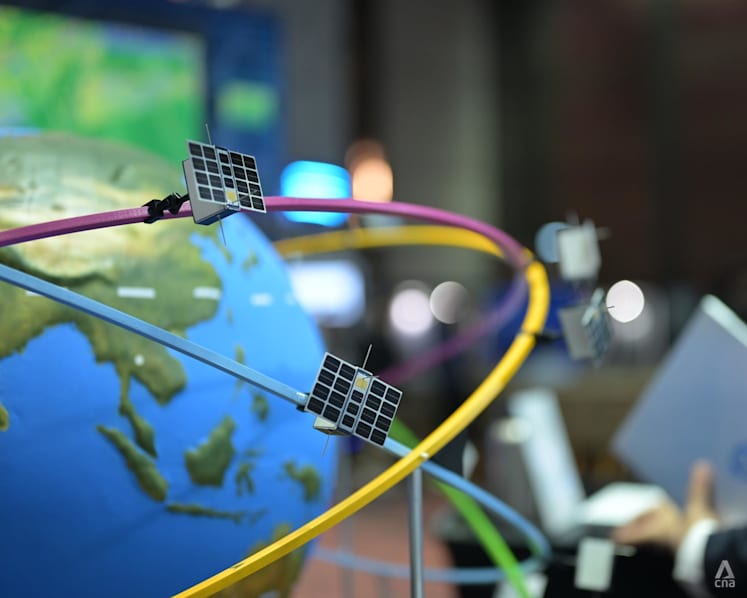 Thailand's longer-term goal is to produce space equipment for international customers. (Photo: CNA/Jarupat Karunyaprasit)
Broader financial challenges extend across Southeast Asia.
Ron Chiong, managing partner at Singapore-based Perpetual Space Ventures, said many emerging space companies struggled to attract private investors, who remained concerned about the high costs, long development periods and uncertain returns.
He said government funding continued to play an important role in supporting early-stage technology development, while private investors often preferred companies that had already demonstrated their capabilities in orbit.
Private investment in space technology across the Asia-Pacific totalled US$5.9 billion between 2016 and 2026, according to industry research, but the vast majority went to companies in China, India, Japan, Australia and New Zealand.
Southeast Asian startups are seeking a greater share of that funding, with Singapore-based Perpetual Space Ventures aiming to raise up to US$50 million for a fund dedicated to the region.
Governments across the region are committing significant resources to developing their space industries. Singapore has set aside US$164 million for space technology projects since 2022, while Vietnam inaugurated a space centre earlier this year built with more than US$260 million in investment, largely supported by Japanese development assistance.
Chiong questioned whether Thailand's proposed spaceport could become commercially sustainable without a broader network of launch companies, investors and customers.
He argued that governments and larger corporations would need to work together to establish the conditions for private investment.
"If you are the only one dancing, there's no party," he said.
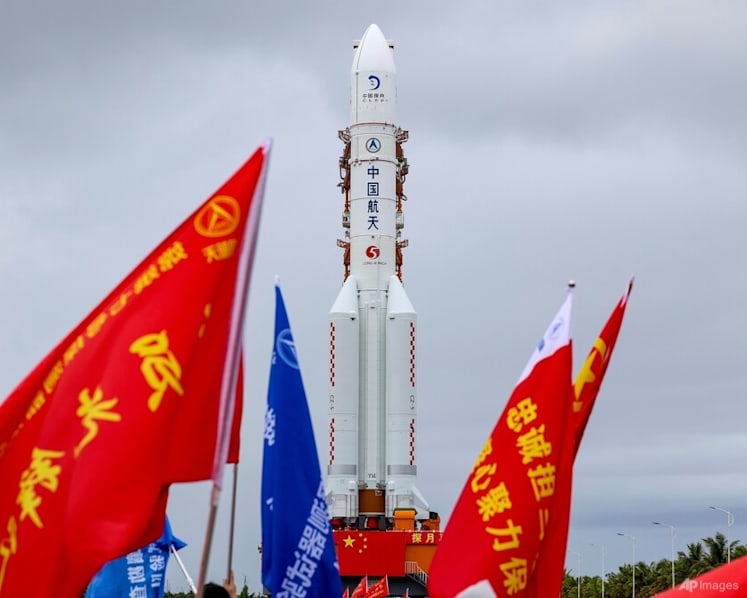 In this photo released by Xinhua News Agency, the combination of the Chang'e-7 lunar probe and the Long March-5 Y14 carrier rocket is transferred vertically to the launching area at the Wenchang Spacecraft Launch Site in southern China's Hainan Province on Wednesday, Aug 19, 2026 . (Yang GuanyuXinhua via AP)
AN “INTERNATIONAL TEAM SPORT”
Regionally, Thailand is not moving in isolation. Across Southeast Asia, governments are investing in satellite technology, domestic manufacturing and Earth observation, while some are exploring their own launch facilities.
The ambitions come amid projections of rapid growth in the global space economy, which the World Economic Forum and consultancy McKinsey estimate could nearly triple in value to US$1.8 trillion by 2035.
In Southeast Asia, a separate February 2025 Deloitte study estimates that wider use of satellite-based earth observation imagery and data could contribute an additional US$100 billion to the regional economy between 2023 and 2030, particularly through applications in agriculture, energy and government services.
Singapore is expanding its commercial space industry, Vietnam is developing satellite capabilities with international partners, and Indonesia and Malaysia have ambitions involving launch infrastructure.
The Philippines is also building its space programme, with plans for a new Earth observation satellite to support agriculture, disaster response and maritime monitoring.
"Several challenges that our nation faces today find solutions from space," said Gay Jane Perez, acting director general of the Philippine Space Agency.
The growing interest comes as advances in technology and falling launch costs make space more accessible to countries that previously lacked the resources to participate.
Enrico Palermo, head of the Australian Space Agency, told CNA that the opportunities were substantial, but countries needed to be realistic about what they could achieve independently.