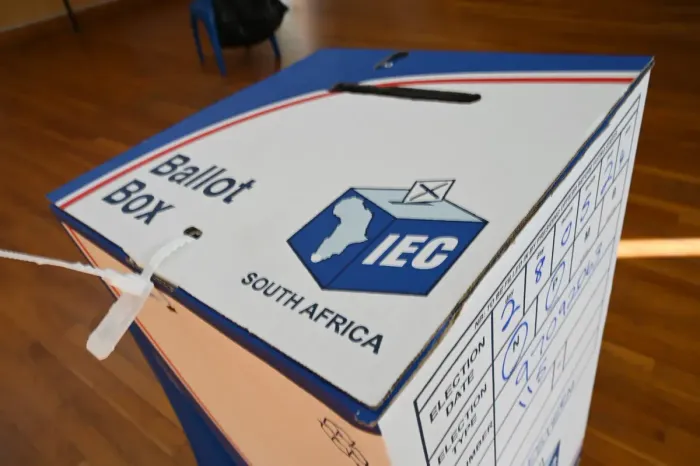
South Africans are gearing up for municipal elections on 4 November.
As voters head to the polls this week, the latest Ipsos survey suggests the ANC could secure only about a third of the national vote, with coalition governments likely to become the order of the day across several major metropolitan municipalities after the November 4 local government election.
The Ipsos Pulse of the People study, released on Friday, surveyed respondents between September 12 and October 13, 2026.
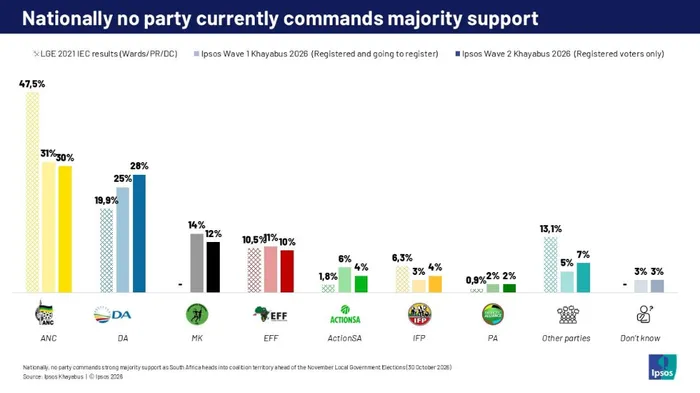
Nationally, the poll puts ANC support at 30%, a significant decline from the 47.5% it secured in the 2021 local government elections.
The MK Party, which will contest a local government election for the first time, polled at 12%, while the DA's support increased to 28%, compared with the 19.9% it received in 2021.
The EFF's support remains at about 10%, while ActionSA and the IFP each polled at 4%, followed by the PA at 2%.
nationally-no-political-party-commands-majority-support
In Johannesburg, the poll shows a closely contested race between the DA and ANC, which polled at 30% and 27% respectively. The EFF has the third-largest support at 12%, closely followed by ActionSA at 11% and the MK Party at 5%.
The DA is also ahead in Tshwane, with 34% support compared with the ANC's 31%. The EFF and ActionSA trail at 8% each.
In eThekwini, the MK Party is projected to secure the largest share of the vote at 47%, followed by the DA at 21% — less than half the MK Party's support — while the ANC trails at 10%.
The poll suggests the DA could also retain control of Cape Town, albeit with a reduced majority, polling at 51% compared with the 58.3% it secured in the 2021 elections.
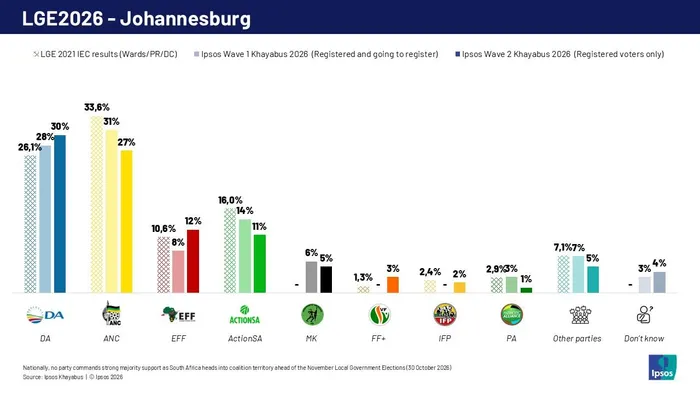
The latest Ipsos poll places the DA ahead in Johannesburg
Ipsos did not publish separate polling figures for the other four metropolitan municipalities, citing a larger margin of error compared with the four biggest metros.
However, its key insights indicate that support for the DA and ANC remains extremely close in Nelson Mandela Bay, suggesting a highly competitive race.
In Ekurhuleni, the ANC is ahead of the DA, although the gap between the two parties is relatively narrow. The MK Party follows in third place, recording its strongest performance outside eThekwini.
In Buffalo City, the ANC appears likely to remain the largest party, although current support levels suggest it could fall short of an outright majority. In Mangaung, the ANC remains ahead, followed relatively closely by the DA and EFF.
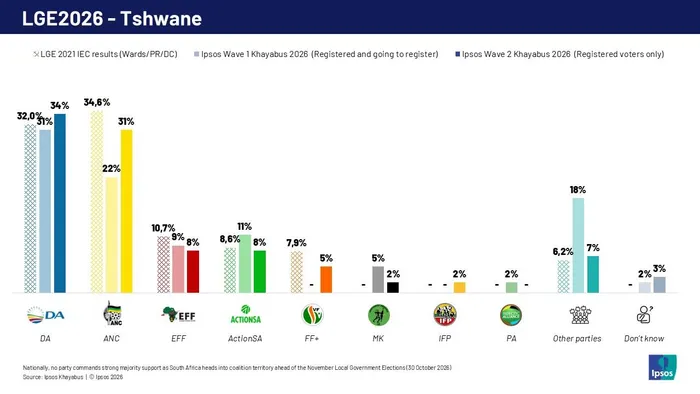
The latest Ipsos polls shows that the DA has pulled ahead in Tshwane at 34% while the ANC is at 31%
Ipsos political analyst in South Africa, Mari Harris, said the survey suggested that new coalition governments were likely in most metropolitan municipalities after the elections, with numerous local and district councils also expected to be governed through coalition arrangements.
“If these survey results are indicative of the level of political support ahead of the elections, most metropolitan areas, if not all, depending on what happens with the DA in Cape Town and MK in eThekwini, are likely to require coalition governments,” said Harris.
“Two weeks of intense speculation and uncertainty are likely to follow the announcement of the final election results, as coalition negotiations take centre stage, particularly in councils where no single party secures a majority.”
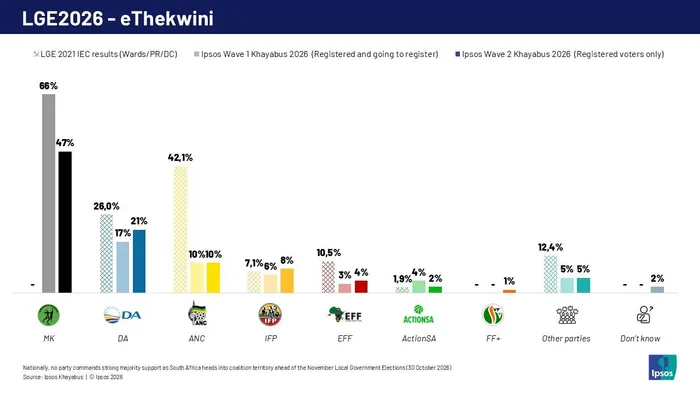
The MK Party has the largest support in eThekweni Metro
According to Ipsos, voter turnout could play a significant role in determining election outcomes in several councils, meaning the final results could differ from the polling projections.
Of the 44.9 million South Africans aged 18 and older who are eligible to vote, only 29.2 million are registered with the Electoral Commission of South Africa (IEC). This represents 65% of the eligible voting population.
The latest Pulse of the People study found that 62% of South Africans agreed with the statement: “I am looking forward to voting in the 2026 Local Government Elections”.
Ipsos said that if turnout on November 4 mirrors that of the 2021 local government elections, only about 12.8 million people could be expected to cast their ballots.
If turnout is similar to that of the 2024 national and provincial elections, about 16.3 million voters could participate.
Although more than 600 political parties are registered with the IEC to contest the 2026 elections, 53% of eligible voters agreed with the statement: “There is no political party that represents my views”. This sentiment was shared by half (50%) of registered voters.
“Voter apathy is widely blamed, but voters are disappointed, disillusioned and frustrated with the situation in the country, especially with lack of service delivery and political promises without any action or any sense of responsibility on the side of many councils,” said Harris.
Illustrating this sentiment, 68% of registered voters said that “Politicians can’t be trusted”, while only 15% disagreed.