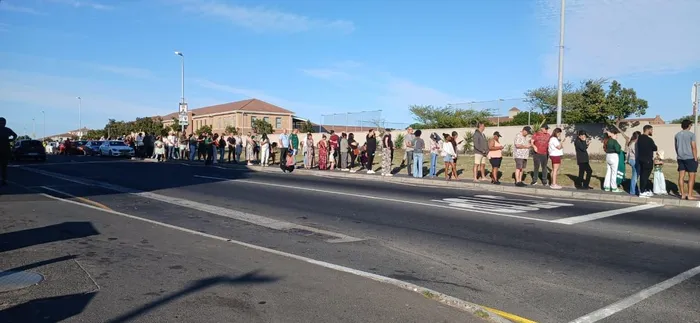
Voters queue along the road outside a voting station in Cape Town on Wednesday as the 2026 local government elections get under way
Voters across Cape Town turned out in the hundreds on Wednesday morning, with some in line before voting stations opened at 7am and others bringing their own camping chairs to make the long wait bearable.
The turnout came two days after the city’s special voting got off to a shaky start, when 217 voting stations in the metro failed to open on time on Monday because special-vote ballot papers arrived late.
In Parklands, the queue snaked from the entrance of CBC St John’s along Dorchester Drive and onto Parklands Main Road.
Many came prepared, bringing snacks and hats as the temperature began to climb.
Inside, voters queued up the stairs to cast their ballots, while people with disabilities and senior citizens were helped to vote downstairs.
In Kraaifontein, Cheslyn Ross, from Scottsdene, was already standing outside Bernadino Heights High School at 6.45am, before the doors opened.
“I was standing in the line before the doors opened because I just wanted it to be done,” Ross told IOL.
“I can sleep now for 10 hours, 11 hours, as long as I want to after this, and in peace as well.
“Your vote means a lot in ensuring that the right people govern the country and also your province.
“My message would be to keep the standards high, don’t compromise, stick to your values and be the example for the next generation.
“There are a lot of things on social media, Facebook, TikTok, and we don’t know what to believe, but I believe if you stick to your principles, it doesn’t matter what people say about you.”
Outside the school, the DA, the ANC and the Patriotic Alliance had set up tables to help residents as they arrived.
Party tables and gazebos are allowed outside voting stations, but the IEC has warned that any campaigning inside a voting station’s boundaries is a crime that can carry a fine or up to five years in prison.
Edward Feltman, 69, from Bernadino Heights, told IOL he had been voting since 1994 but had not seen any changes, and hoped that this time his vote would count.
He said water and electricity had been his main concerns.
Fellow Kraaifontein resident Themba Ntozana said he wanted better services and, above all, work.
“What prompted me to vote is that I want better services from the municipality,” Ntozana said.
“These jobs help put food on the table.”
He said employment remained a lifeline for many families in Kraaifontein as the cost of living kept rising.
In the city centre, voters also arrived in numbers at the Cape Town Civic Centre, the seat of the city’s council.
The DA, which has run Cape Town since 2006, is hoping to keep its grip on the metro, with mayor and party leader Geordin Hill-Lewis seeking a second term.
Hill-Lewis is expected to cast his ballot at Edgemead Primary School.
The latest Ipsos poll, released on Friday, put the DA on just over half of the vote in Cape Town.
Political analyst Dr Oscar van Heerden told IOL he expected the DA to hold on to its majority in the city, but with fewer votes.
“I think the Patriotic Alliance is going to gain some of the so-called coloured votes that traditionally voted DA and they are now going to vote PA,” Van Heerden said.
“So I think that Gayton’s party might get some good representation in the council potentially.”
GOOD leader Patricia de Lille told IOL that whoever governed Cape Town after the election would have to rearrange the city’s budget to spend more in previously disadvantaged areas.
“So the first thing is that you have to arrange your budget or rearrange your budget that your budget becomes pro-poor so that you spend more in the previously disadvantaged areas than in the other areas,” De Lille said.
“The other areas, maintain them to the same standards, but take the same quality of services to the previously disadvantaged areas.
She said city-owned and public land had to be used to build homes closer to jobs for people in areas such as Mitchells Plain and Khayelitsha, far from the city centre.
In the Western Cape, 148,493 people cast special votes on Monday and Tuesday, according to the IEC.
Voting stations close at 9pm, and voters still in the queue at closing time will be allowed to vote.