South Korea’s economy has been heavily boosted by demand for advanced chips used in AI, lifting exports and the earnings of memory chip makers Samsung Electronics and SK Hynix.
South Korean President Lee Jae Myung leaves after delivering a budget speech for 2027 at the National Assembly in Seoul, South Korea, on Nov 2, 2026. (Photo: Lee Jin-man/Pool via Reuters)
South Korean President Lee Jae Myung leaves after delivering a budget speech for 2027 at the National Assembly in Seoul, South Korea, on Nov 2, 2026. (Photo: Lee Jin-man/Pool via Reuters)
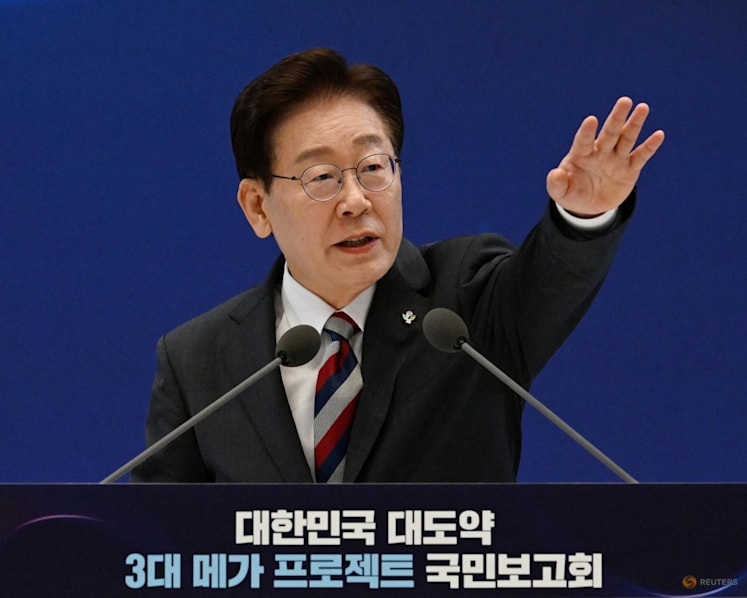
SEOUL: South Korean President Lee Jae Myung vowed on Monday (Nov 2) to make bold investments in artificial intelligence to boost the country's economic growth potential, in an address to parliament seeking approval for next year's budget.
"We will invest 21.3 trillion won (US$15.97 billion), nearly twice this year’s amount, in AI and the three megaprojects of semiconductors, physical AI and AI data centres," Lee said.
His administration proposed in September increasing government spending by a record 12.8 per cent next year to 820.9 trillion won aiming to strengthen South Korea’s technological edge as global competition over AI intensifies.
South Korea’s economy has been heavily boosted by demand for advanced chips used in AI, lifting exports and the earnings of memory chip makers Samsung Electronics and SK Hynix.
CNA Games
 Guess Word
Crack the word, one row at a time
 Buzzword
Create words using the given letters
 Mini Sudoku
Tiny puzzle, mighty brain teaser
 Mini Crossword
Small grid, big challenge
 Word Search
Spot as many words as you can
Show More
Show Less
Asia's fourth-largest economy grew faster than expected in the third quarter on chip exports and investment. From January to October, exports totalled US$930 billion, on track to exceed US$1 trillion this year and make South Korea the fourth country in the world to reach the milestone after the United States, China and Germany.
Lee said annual exports of US$1 trillion were now within reach, but warned that the benefits were not being shared evenly.
"We must make a great transition from ‘growth for the few,’ in which opportunities and gains are concentrated among certain regions, classes and a small number of companies, to ‘growth for all,’” he said.
The budget includes a 162.3 trillion won Future Response Fund, financed largely by additional tax revenue from the semiconductor boom, to support growth industries, young people, regional development and education while providing a buffer against future revenue shortfalls.
Lee is simultaneously pursuing nationwide megaprojects centred on chips, physical AI and data centres, including an 800 trillion won private sector chip buildout led by Samsung and SK Hynix in the country's southwest.
Week in Review

Our chief editor shares analysis and picks of the week's biggest news every Saturday.
Morning Brief
An automated curation of our top stories to start your day.