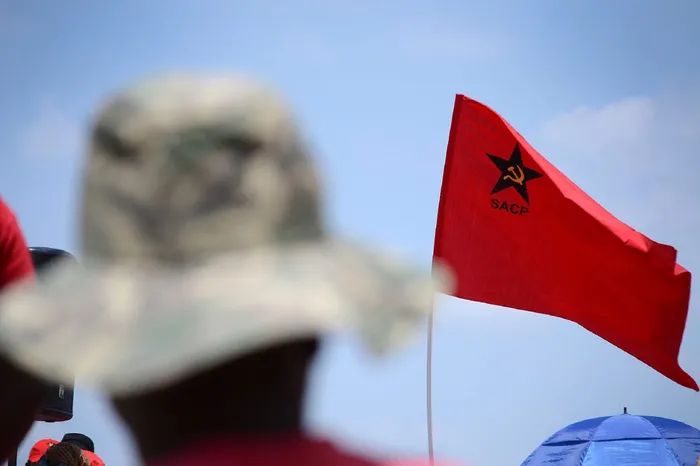
Cosatu affiliated unions will back both the ANC and the South African Communist Party (SACP) in Wednesday's election.
Cosatu’s attempt to keep the ANC-SACP alliance together is exposing divisions within the trade union federation, with its affiliates backing rival parties or refusing to support either as South Africa heads into Wednesday’s local government elections.
While some unions are campaigning for the ANC, others have thrown their weight behind the South African Communist Party (SACP), which is contesting the elections independently. The split has raised questions about whether Cosatu can maintain unity while allowing its affiliates to take different electoral positions.
The divisions were evident this week when the South African Municipal Workers’ Union (Samwu) in Limpopo mobilised support for the ANC, saying the SACP’s campaign was not visible on the ground.
Samwu’s Limpopo provincial secretary, Patrick Aphane, said the union’s position followed a resolution at Cosatu’s recent 15th National Congress to support “the ANC where it is strong and the SACP where it is strong”.
“SACP in Limpopo can’t be found on the ground, but the ANC is on the ground. The other thing is that SACP may be strong in what is called voter district and as Samwu, we are not organising there. We are not organising in branches, but we are organising in municipalities,” Aphane said.
Cosatu says affiliates can support either party
Samwu president Nkhetheni Muthavhi said the Limpopo leadership’s decision did not mean provincial structures were acting independently of the union’s national leadership or its conference resolution.
He said Samwu supported Cosatu’s position of backing both the ANC and SACP, with the added qualification that affiliates should support whichever party appeared to have a stronger chance of winning in a particular area.
Muthavhi acknowledged that the arrangement could appear confusing to the public, but said union leaders would sometimes support the ANC and at other times the SACP.
“We tried to take a middle ground because we didn't want to be torn between the ANC and SACP that are contesting each other. So, there's nothing untoward,” he said.
The differences reflect the growing tension between the alliance partners as the SACP prepares to contest the local government elections independently while remaining part of the historic alliance.
The federation's leadership has also undergone a change, with Mike Shingange elected as Cosatu president at its recent congress.
Unions take different positions on election support
Other Cosatu affiliates have made their positions clear.
South African Democratic Teachers’ Union spokesperson Nomusa Cembi said the union had thrown its support behind the ANC, in keeping with its conference resolution.
The National Education, Health and Allied Workers Union (Nehawu), however, remains firmly behind the SACP.
Nehawu spokesperson Lwazi Nkolonzi said the union was sticking to its conference resolution and dismissed suggestions that the decision risked alienating the ANC.
He said the resolution “did not consider any political party other than the SACP”.
The union had previously committed to supporting the SACP’s independent 2026 election campaign.
The Police and Prisons Civil Rights Union (Popcru) said it would not support either party.
Spokesperson Richard Mamabolo said the union’s provincial executive council had resolved that “we are not going to support anyone but we are going to support the unity of workers”.
“We never really took sides. We appreciate that our members come from diverse political organisations even beyond the alliance,” he said.
Experts warn of growing divisions in the alliance
Professor Ntwanano Mathebula from the University of Johannesburg’s School of Public Management, Governance and Public Policy described developments within Cosatu, particularly among its affiliates, as “really concerning”.
He said Samwu-Limpopo’s position reflected the union’s historical support for the ANC and its willingness to campaign openly for the party.
“I think what we have heard from Samwu-Limpopo is the fact that they will go with history of supporting the ANC. And they came out unapologetic and said it with a bold voice to say that they wouldn't only be supporting the ANC, but they would even go to an extent of mobilising for the ANC, which of course we have not heard from Cosatu,” he said.
Mathebula said several developments had contributed to tensions, both within Cosatu and across the broader alliance.
These included Mike Shingange’s election as Cosatu president, ANC national chairperson Gwede Mantashe’s walkout at the Cosatu congress and the continuing deterioration of relations between alliance partners.
He said Samwu’s support for the ANC was also influenced by the party’s history of engaging with the union on labour-related concerns.
“And one of the reasons why Samwu says that they would want to vote for the ANC is because they say the ANC has always been there to hear them out whenever they have issues that have to do with labour,” he said.
Political commentator Lesego Masisi said Cosatu’s resolution should be understood as an attempt to preserve unity among affiliates that had adopted different positions on the ANC and SACP.
“With Nehawu supporting the SACP and other affiliates supporting the ANC, imposing a single electoral position risked deepening divisions within the federation. Given the circumstances confronting the federation, permitting affiliates to support either organisation was a procedurally defensible compromise,” he said.
Masisi said organisational unity did not necessarily require all affiliates to take the same position at the ballot box.
“The ANC and SACP remain constituents of the same historical Alliance, notwithstanding their electoral competition. Consequently, supporting either organisation does not, in itself, constitute an abandonment of the alliance’s historical programme,” he said.
He said the immediate consequence of the arrangement in the November elections could be a redistribution of electoral support between the ANC and SACP.
“However, this should not be understood merely as a question of one organisation gaining votes at the expense of another. Its greater political significance lies in the possibility of reconfiguring the relations of power between alliance partners, including within municipal councils,” he said.