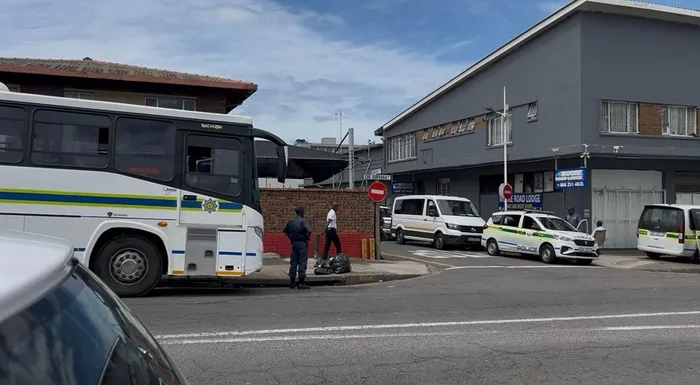
Public Order Police outside the Home Affairs Durban Refugee Reception Centre on Che Guevara Road.
Home Affairs Minister Leon Schreiber said his department is on track to implement the online registration and appointment system for asylum seekers by November 10, 2026, as announced by the Inter-Ministerial Committee (IMC) on Migration.
The IMC announced the online system earlier last month after the government considered the legal implications of the judgment handed down on July 7, 2026, that declared sections of the Refugees Act, which allowed for immigration officials to deport an asylum seeker if they are in the country without a transit visa, unconstitutional.
The judgment was followed by a misinformation campaign and heightened protests in Durban.
The Judge President of the Gauteng Division has since referred 33 urgent applications to a full court to determine important legal and constitutional questions concerning the detention of undocumented foreign nationals who express an intention to apply for asylum.
The hearing, which was to be heard on October 29, 2026, was postponed to be heard from November 16 to 18, 2026.
Responding to parliamentary questions from MK Party MP Irvin Serame Mogale, Schreiber said the system will introduce an orderly, scheduled, and biometrically verified registration process in place of unscheduled walk-in applications.
“Registration on the system does not confer asylum status, permanent residence, citizenship, voting rights, or amnesty. The department will continue to enforce the Immigration Act,” he said.
Asked what cyber countermeasures have been put in place to guarantee the safety of the online programme, Schreiber said the system was subject to the department's information security standards.
He added that additional measures were being implemented to strengthen its resilience against potential cyber threats.
“Given the security-sensitive nature of the system, it would not be appropriate to disclose specific cybersecurity measures publicly.”
The minister said the department has not appointed additional staff to process asylum applications, and that no additional expenditure has been incurred.
Mogale also asked Schreiber about the reasons the same effort has not been introduced to alleviate long queues in some Department of Home Affairs offices, especially for Smart ID Card applications.
In response, Schreiber said he and other IMC ministers had intended to approach the courts to seek a supervisory order that would enable the Constitutional Court to retain oversight of the implementation of its judgment and provide guidance on the practical requirements for compliance.
“Such an order may also provide for a suspension period to allow the department sufficient time to strengthen the administrative, human resource, infrastructure, and processing capacity required to implement the judgment effectively.”
Regarding measures to reduce queues for Smart ID Card applications, Schreiber explained that the department was implementing its reform programme, which included expanding access to Smart ID Card services through its partnership with the banking sector.
“The partnership has expanded to 659 bank branches, contributing to a 208% increase in the national footprint for Smart ID Card services over the past two years. In just seven months, approximately one million South Africans have applied for Smart ID Cards through participating bank branches.
“This expansion has alleviated pressure on traditional Home Affairs offices by redirecting Smart ID Card applications to participating bank branches, thereby reducing queues and improving access to services at Home Affairs offices.”
Meanwhile, Schreiber said staff shortages contributed to operational pressures at certain Home Affairs Department offices and exacerbated queues and delays in service delivery.
“However, these challenges are not attributable to staffing alone, as system outages and other operational factors also affect service delivery,” he said when he was replying to separate questions from EFF MP Paulnita Marais.
Schreiber said his department has prioritised 724 posts as at September 30, 2026.
The posts were at various stages of being filled, and 78% of the total vacancies were based in provinces.
He added that the department’s digitalisation programme was augmenting existing staffing capacity by automating processes and expanding digital service channels amid staffing constraints largely linked to budget pressures.
“Digital literacy training is also being implemented to strengthen employees’ capacity to operate in a digitally enabled service environment.”