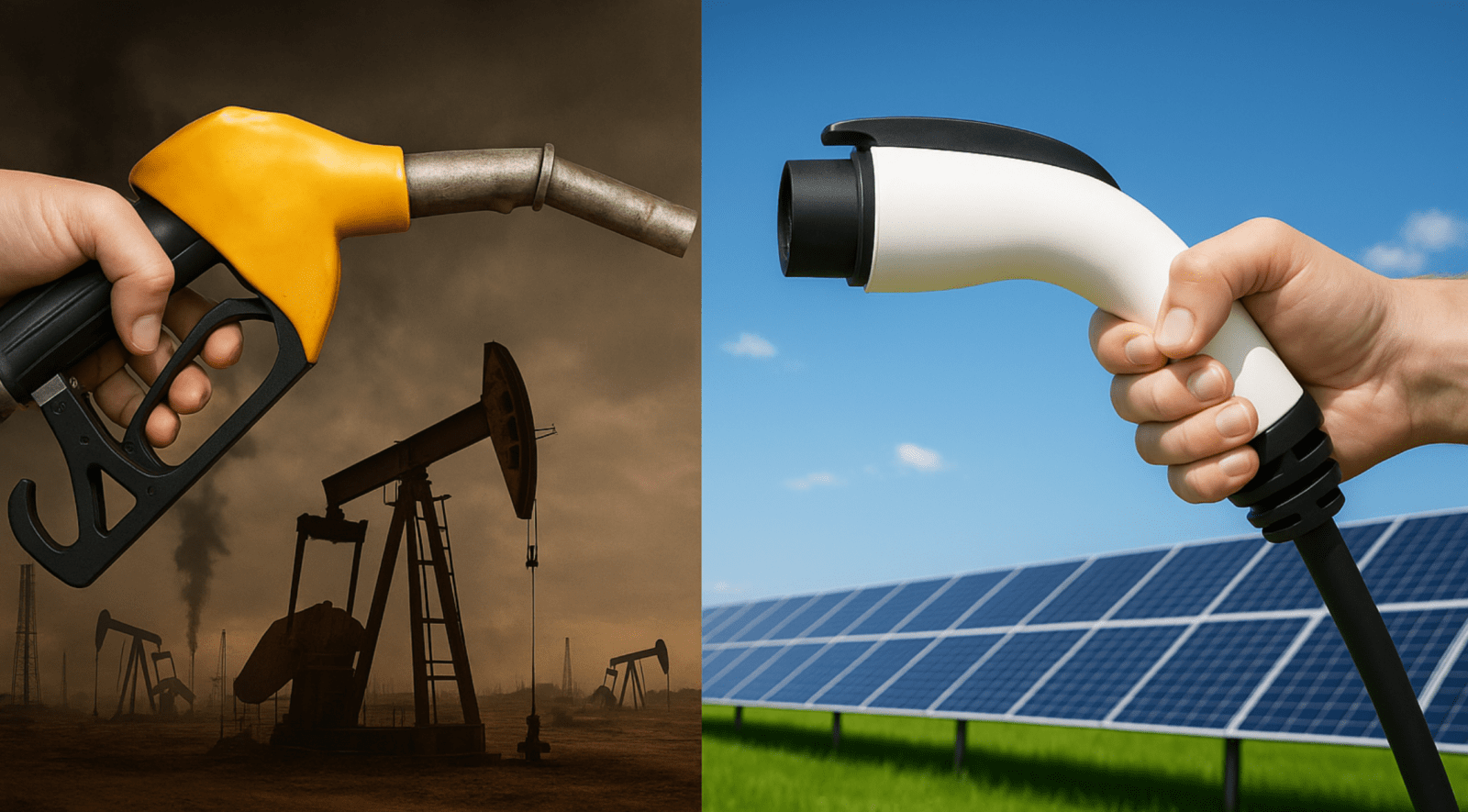
Battery-electric cars took a record 37% of Germany’s new car market in October, according to data released today by the Kraftfahrt-Bundesamt (KBA), the country’s federal motor vehicle authority. That’s 94,086 BEVs, up 79.5% from 52,425 a year earlier.
For the second month in a row, German buyers registered more fully electric cars than gasoline and diesel cars combined. And with two months left in the year, Germany has already blown past the auto industry’s EV forecast for all of 2026.
A record month in a record year
The overall market barely grew in October. Total new car registrations rose 1.7% to 254,492 units, which means the EV growth came straight out of combustion cars.
Gasoline car registrations crashed 40.5% to 38,516 units, a 15.1% share. Diesel fell 21.6% to 23,882 units, or 9.4% of the market. Add them up and pure combustion cars made up just 24.5% of new registrations, 12.5 points less than BEVs alone.
Plug-in hybrids slipped 7.9% to 28,499 units (11.2%). So plug-ins accounted for about 48% of the German market last month, and the average CO2 emissions of new cars dropped 21.1% year-over-year to 79.4 g/km.
As we reported this summer, BEVs became the most popular powertrain in Germany for the first time in June with a 28.4% share. They’ve kept climbing every month since: 32.4% in August, 34.5% in September, and now 37% in October.
 Battery-electric cars outsold gasoline and diesel combined in Germany in October. Data: KBA
Through the first ten months of the year, Germany has registered 698,230 BEVs, up 60.7% year-over-year. That’s about 28.2% of the 2,476,290 new cars registered in 2026 so far, up from roughly 19% for the full year 2025.
 BEV share of new car registrations in Germany by month, 2026. Data: KBA
And the industry didn’t see it coming. In December, the VDA, Germany’s auto industry association, forecast about 693,000 BEV registrations for all of 2026. Germany passed that in October. At the current pace, it’s on track for somewhere around 875,000 by the end of the year.
The subsidy is working
The biggest driver is Germany’s new EV incentive, which applies retroactively to cars registered since January 1. It pays €3,000 for a new BEV, bought or leased, and up to €6,000 for lower-income households with children. Households with taxable income above €80,000 (€90,000 with kids) don’t qualify.
The program targets private buyers, and that’s exactly where the KBA data shows the jump. Private registrations rose 20.6% in October, while commercial registrations fell 8.2%. Private buyers now make up 40.7% of the market.
Germany has been here before. The government killed its previous EV incentive overnight in December 2023, and BEV sales fell off a cliff in 2024. This time, the money is going to the buyers who need it most, and it’s moving the needle fast.
BYD edges out Tesla, Chinese brands surge
Tesla’s German numbers swing wildly with its quarterly delivery cycle. In September, the end of the quarter, it registered 12,552 cars (+268.7%) and the Model Y was the best-selling car in Germany. In October, it registered only 2,932, which is still up 290.9% but from a tiny base, for a 1.2% market share.
Year-to-date, Tesla is up 206.1% to 47,742 registrations. That’s a big rebound from a terrible 2025, but BYD is now slightly ahead with 47,961 (+216.1%). BYD registered 5,173 cars in October (+54.3%), though the majority of its German sales are plug-in hybrids, not BEVs.
The other Chinese brands are growing even faster. Leapmotor registered 3,661 cars in October, up 288.6%, and is at 19,705 for the year. Xpeng was up 284.4% to 1,380 units, and SAIC’s MG was up 48.5% to 4,140.
Volkswagen Group still owns the top of the EV charts, though. Through September, the Skoda Elroq was Germany’s best-selling EV with 30,845 units, ahead of the Tesla Model Y (29,464) and the VW ID.3 (24,352).
German automakers aren’t cashing in
The EV boom is happening during one of the worst years in the history of Germany’s auto industry.
In October, the VW brand’s German registrations fell 4%, Audi dropped 8.4%, Porsche lost 5.7%, and Opel crashed 24.1%. BMW was flat (+0.1%), and Mercedes was the exception, up 8.5%. VW is still by far the biggest brand in Germany with an 18.2% share, but it’s down 5.6% for the year.
 Year-over-year change in German registrations by brand, October 2026. Data: KBA
Last week, Volkswagen Group reported a €5.9 billion operating loss for the third quarter, its biggest quarterly loss since Dieselgate, driven by a writedown of its Porsche stake, weak sales in China, and thin EV margins. The group has already approved a plan to cut 100,000 jobs and close several German plants. Mercedes cut its 2026 car margin guidance to 2-3% last week, mainly because of China.
It’s not a product problem. VW’s new ID. Polo is sold out with over 30,000 orders, BMW has over 50,000 orders for the Neue Klasse iX3, and the Elroq leads the German EV market.
Electrek’s Take
Germany is proving what we’ve been saying for years. Give buyers EVs they can actually afford, and they switch fast. Fully electric cars went from about 19% of the market last year to 37% in October, and the country beat the industry’s full-year forecast with two months to spare. That’s not a slow transition.
Compare that with North America, where EV sales dropped 44% after the US killed its federal EV tax credit. Same technology, sometimes the same cars. The difference is policy.
Germany’s problem is who’s capturing the demand. Hint: it’s not German automakers.
But whose fault is that? You can’t spend years dragging your feet on electrification and lobby government back and forth on EV incentives and then complain when those who are all-in on EVs are able to take better advantage of the customer shift amid another oil crisis.
If you’re buying an EV, powering it with home solar can cut your fuel costs to nearly zero. With electricity rates up almost 10% last year and expected to keep climbing, going solar is one of the best ways to protect yourself against rising costs. And with lease and PPA options, you can do it with zero upfront cost and start saving immediately. If you want to find the best deal, check out EnergySage. It’s a free service with hundreds of pre-vetted installers competing for your business, so you save 20 to 30% compared to going it alone. No sales calls until you pick an installer. Get your free quotes here.
FTC: We use income earning auto affiliate links. More.
Subscribe to Electrek on YouTube for exclusive videos and subscribe to the podcast.