New toxicology tests of Incan mummies found the kids were given not just cocaine but also alcohol and chemicals found in ayahuasca before the ceremony
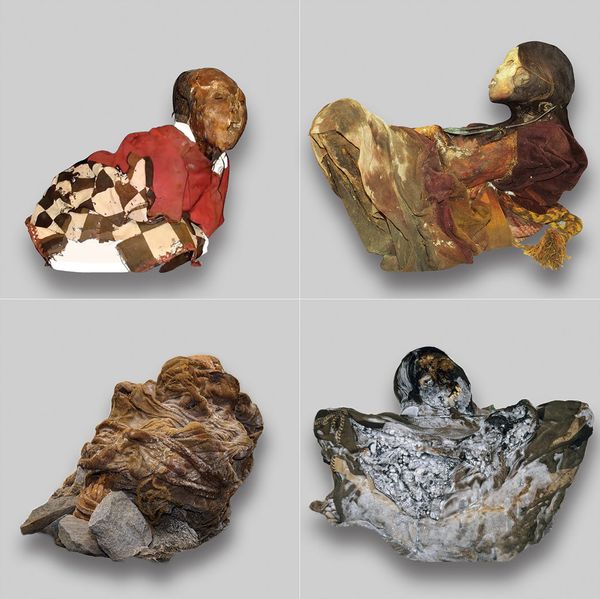
Photographs of the mummified remains of Incan individuals who were used in ritual sacrifices.
Photos via Antiquity
Photographs of the mummified remains of Incan individuals who were used in ritual sacrifices.
The ancient Inca sacrificed children who were drugged with cocaine, a powerful hallucinogen and, in some cases, alcohol, according to a new study in Antiquity. The discovery reveals new macabre details of how these ancient peoples chose to honor their gods.
During the reign of the Incan Empire, which spanned a large territory in western South America from the 13th to the 16th centuries, children and young women were regularly sacrificed to important gods in a ceremony known as capacocha. They were meant to act as messengers between the living and the deities. The rituals were conducted in an effort to restore stability after events such as a famine or drought. Before they were killed, those chosen for sacrifice were taken to Cusco, the capital of the Incan Empire, or to temples or oracles scattered throughout the territory.
As they were prepared, the children were given an array of psychoactive plants. Though previous studies had found that these included coca leaves—the main ingredient in cocaine—tests for other substances had been largely inconclusive or negative.
On supporting science journalism
If you're enjoying this article, consider supporting our award-winning journalism by subscribing. By purchasing a subscription you are helping to ensure the future of impactful stories about the discoveries and ideas shaping our world today.
“Our aim was to identify a broader range of psychoactive substances administered to the children and to determine whether patterns in their use could provide new insights into how capacocha ceremonies were conducted at different locations,” said Dagmara Socha, an archaeologist at the University of Warsaw, in a statement. “Recent advances in toxicology now allow for the identification of low concentrations of such substances.”
When Socha and his team conducted toxicology exams on hair and nail samples from eight bodies discovered near several Incan sacrificial sites in Peru and Argentina, they found that each body had at least one intoxicant present. All the bodies contained traces of cocaine and benzoylecgonine, a chemical produced by the body as it metabolizes the drug. Cocaine may have been given to the children to help them deal with altitude sickness and fatigue as they climbed the mountains where the sacrifices took place.
Four of the mummified corpses also tested positive for alcohol, which likely came from drinking chicha, a beer made out of maize. Historical records show the drink was given to the children in order to calm them during the final parts of the ceremony.
Three of the bodies contained traces of harmine and harmaline, two chemicals found in the hallucinogen ayahuasca. “Harmine is an alkaloid associated with Banisteriopsis species, one of the principal plants traditionally used in the ayahuasca beverage,” Socha said. “It may indicate that a harmine-containing beverage had a specific role in ceremonies connected with this particular sacred mountain.”
In the study, Socha didn’t rule out that other substances may also have been given, but aren’t detectable with current technology. But the differences in results in the bodies do show that the capacocha ceremony wasn’t uniform, and could vary by geography and by which god was being venerated.
“Five hundred years after these children were sacrificed during one of the most important Inca rituals, new technologies are allowing us to uncover details of their lives and Inca religious practices,” Socha said. “What we are seeing is that the capacocha was not a single standardized ritual, but rather, the Incas appear to have adapted it to different cults and local religious traditions.”
Great science journalism requires human expertise, time, effort and creativity. And it costs money. That’s why I and the journalists here at Scientific American hope you’ll join our community.
When you subscribe, you are supporting staff and freelance journalists who are passionate about telling science stories that are true, important and compelling. Our editors and reporters are often experts in their fields, which means they understand the nuances of big discoveries and can untangle the breakthroughs from the hype. With a subscription, you are also supporting rigorous fact-checking to ensure the words we publish are precise and accurate. And you’re supporting original illustrations, graphics and photos that bring you closer to an advanced laboratory, an ice sheet in Antarctica or a space mission in orbit. You’re helping us craft other types of high-quality journalism as well: Our newsletters are carefully written, edited and curated by staffers you have or will come to know and love. Our Science Quickly podcast is based on original reporting, collaboration with editors and scientists and exacting production.
Subscriptions keep this engine running so we can continue to deliver thoughtful, rigorous and independent science journalism to you. In an era of viral misinformation, this work is crucial. If you value what we do, I hope you’ll consider joining us as a subscriber