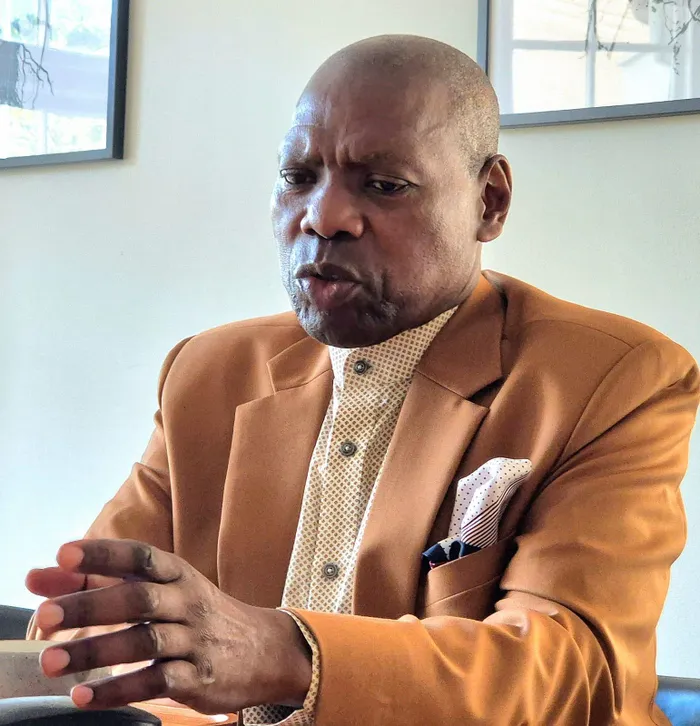
The chairperson of Parliament's Portfolio Committee on Cooperative Governance and Traditional Affairs Dr Zweli Mkhize held an exclusive interview with the National Media Group on the state of local government ahead of the elections.
The growing prevalence of coalition governments could pose significant challenges for South African municipalities after the November 4 local government elections, with political parties urged to prioritise service delivery over power struggles and political brinkmanship.
Dr Zweli Mkhize, chairperson of Parliament's Portfolio Committee on Cooperative Governance and Traditional Affairs (Cogta), says coalitions are likely to become a permanent feature of local government, making political maturity, dialogue and accountability essential to stable municipal governance.
Speaking exclusively to National Media Group in Durban on Wednesday, the former Cogta Minister said the country was likely to have even more hung municipalities than the 82 recorded after the November 2021 local government elections.
“Coalitions might become a permanent feature. In 2016, we had 27 hung municipalities. In 2021, we had 82 hung municipalities, and there will definitely be more this time around.
“This means that the luxury of a single-party majority will become very scarce,” said Mkhize.
He said political parties needed to develop a better understanding of coalition governance, establish clear agreements and remember that their primary responsibility was to the electorate.
“There is a need for parties to sign agreements and remember the public commitment. Start a culture of agreements and fear the public, not the legal representatives of your coalition partners.
“In these situations you have to manage relationships. Competing interests complicate relations. Dialogue must guide relations instead of bullying each other. Prioritise solutions instead of conflict. Manage conflicts as they manifest into votes of no confidence.
“You can win adversaries if you focus on community,” he said.
Bill could curb political instability
Mkhize believes the proposed provisions in the Coalitions Bill could help stabilise municipalities by addressing some of the political practices that have undermined coalition arrangements.
He said the Bill sought to address the abuse of motions of no confidence against mayors, shift the focus towards service delivery and provide clarity on how soon parties could form coalitions after an election.
“The Bill is still in the making,” he said, adding that the South African Local Government Association (Salga) could assist political parties by developing guidelines.
Mkhize pointed to the Johannesburg metropolitan municipality, where a record 84 political parties, including independent candidates are contesting Wednesday's elections, as an example of the growing fragmentation of local politics.
Harking back to the Johannesburg Metro's situation as “dramatic” where the mayoral chain has changed hands seven times, since November 2021, attributing it to a lack of seriousness among some political parties, difficulties in managing competing personalities and attempts by parties to control particular municipal portfolios.
“We therefore hope that parties understand that people wanted the best people, not political bickering. In the end we want parties to understand the priority of service delivery.”
Electoral threshold to curb fragmentation
Mkhize said discussions had taken place about introducing an electoral threshold to limit political fragmentation and improve the functionality of municipal councils.
Using eThekwini as an example, he said four parties accounted for 84% of the vote, while an electoral threshold could potentially eliminate 11 smaller parties from representation.
“You won't force people anywhere to vote for majority rule. You need a common approach by parties,” he said.
The issue of electoral thresholds also came up in the initial draft of the final revised White Paper on Local Government, which was welcomed by the Cogta Portfolio Committee on October 23.
Mkhize said the proposed mechanism, which included a provision relating to the greater remaining fraction in the allocation of council seats, had featured in the draft White Paper but was subsequently removed following legal advice.
He said the intention was to address excessive political fragmentation in municipal councils, which complicated governance and coalition arrangements.
“Some people were accusing the party of trying to get back into power, overlooking the fact that the Minister (of Cogta) is not the ANC,” said Mkhize, pointing out that the drafts had been developed by technical bureaucrats.
Greater accountability in local government
Beyond coalition politics, Mkhize said local government continued to be undermined by poor performance, negative audit outcomes, maladministration, inadequate service delivery, deteriorating infrastructure, unreliable basic services, poor road conditions, water and sanitation problems, and human settlements challenges.
He called on political parties to prioritise training and developing public representatives to address the widespread incompetence affecting municipalities.
“Political parties need to invest in the new councillors. It makes leadership strong,” he said.
Mkhize said accountability and a lack of understanding of governance responsibilities were among the major concerns highlighted in the Auditor-General's reports.
“Everyone needs to know their roles. Leaders have to oversee procurement and accountability.
“Accountability is not just the function of the clerk but is a reflection of the whole organisation,” he said.
He said political parties had a particular responsibility to monitor their deployed councillors because they were best positioned to identify problems and intervene before government authorities had to step in.
“Political parties are closest to their members. They are the ones who deploy members as councillors, so they should monitor them closely and act when something is irregular. They should not wait for the government to identify problems when they are much closer to their members.”
He also criticised the lack of accountability in cases of maladministration, saying local government leaders needed a better understanding of the legal implications of their decisions.
Treasury intervention defended
Mkhize also defended National Treasury's decision in July to freeze equitable share transfers to 69 dysfunctional municipalities across all nine provinces, using Section 216(2) of the Constitution.
He described the simultaneous intervention as the largest and most sweeping collective enforcement action ever taken against South African local government.
He said the committee supported Treasury's intervention, citing procurement irregularities and financial misconduct by some municipal officials.
“There will be punishment when you don't behave. The issue starts when they don't fulfil their obligations. Some officials got involved in procurement transgressions and financial misconduct. That's why we had to step in.
“We do support actions that call for accountability. We don't support action that is only taken when Treasury acts.”